Sunday, June 24, 2012
Cure for the Common Core!
After much wrangling with the iBooks store, Cure for the Common Core has finally found a home at Amazon!
Cure for the Common Core is a collection of blog posts from the last two years of preparing for and implementing the Common Core Standards. Collected here together for the first time, this book offers insights and actionable strategies for teachers aligning their curriculum to the new standards.
I've updated with a couple of new chapters on building capacity and protocols for making growth happen!
YOU CAN ACCESS THE NEW BOOK HERE!
-Mike
Monday, June 18, 2012
2012 Virtual Summer Camp for Teachers!
It’s FINALLY here! The 4th Annual Virtual Summer Camp for Teachers has launched and is ready for your exploration! This year’s iteration is through a service called Learni.st, which is a lot like Pinterest but for educators!

CLICK HERE TO GO VIRTUAL CAMPING NOW!
The Virtual Summer Camp for Teachers is an opportunity for anytime learning. Now that school is out for the summer, virtual camping gives teachers the resources to explore whenever they have the time!
This year, the organization of the camp is a little different than in previous years, as each section of the Virtual Summer Camp is split into particular interest areas. Those areas include:
Common Core Resources
Essential Apps for Educators
Webinar and Online PD opportunities
A Virtual Crafts section
& a Mess Hall with fun foods and recipe ideas!
Also, on July 24th, there will be a LIVE component as I host an ASCD Webinar on the Virtual Summer Camp with access to a brand new section around the most awesome web tools to use for instruction. The best part is, the webinar is FREE! Information about registration and content can BE FOUND BY CLICKING HERE!
Also, if you’re interested in previous years’ Virtual Summer Camps, they are all still online and available and can be accessed here:
Virtual Summer Camp Year 1
Virtual Summer Camp Year 2
Virtual Summer Camp Year 3
Happy Camping!
Mike on Twitter
http://digigogy.com
Image from Google Docs Stock Image Collection 2012
...
CLICK HERE TO GO VIRTUAL CAMPING NOW!
The Virtual Summer Camp for Teachers is an opportunity for anytime learning. Now that school is out for the summer, virtual camping gives teachers the resources to explore whenever they have the time!
This year, the organization of the camp is a little different than in previous years, as each section of the Virtual Summer Camp is split into particular interest areas. Those areas include:
Common Core Resources
Essential Apps for Educators
Webinar and Online PD opportunities
A Virtual Crafts section
& a Mess Hall with fun foods and recipe ideas!
Also, on July 24th, there will be a LIVE component as I host an ASCD Webinar on the Virtual Summer Camp with access to a brand new section around the most awesome web tools to use for instruction. The best part is, the webinar is FREE! Information about registration and content can BE FOUND BY CLICKING HERE!
Also, if you’re interested in previous years’ Virtual Summer Camps, they are all still online and available and can be accessed here:
Virtual Summer Camp Year 1
Virtual Summer Camp Year 2
Virtual Summer Camp Year 3
Happy Camping!
Mike on Twitter
http://digigogy.com
Image from Google Docs Stock Image Collection 2012
...
Thursday, June 14, 2012
Professional Filters (Know Your Digital Footprint)
I’m updating a post that I wrote several years ago for a wiki I created around Digital Learning Networks...i.e. online PLN”s. There seems to be a dramatic increase lately in the number of smart, professional people making not so smart and unprofessional mistakes online. There are a few things that we all should consider:
Since learning to network effectively reduces some aspects of privacy, it's important to understand what transparency really means. There have been several articles recently about professionals, both in and out of educational settings, being reprimanded for their use of social networking sites at work or related to work. Articles such as THIS ONE from the UK, where a teacher was "tweeting" about their students' and their own lack of enthusiasm, or describing student performance is an obvious no-brainer. If you are blurring the lines between your personal and professional persona on the web, you still need to understand that what you say, what you post, and what you share is viewable by many, many people.
I’m saying this knowing full well how I operate online. I’m very cognizant about what I post, though I tend to completely blur the lines between professional and personal. I talk about this with teachers in workshops. I call what I do online “Profersonal.” It means that I post personal updates about myself and my family, knowing fully well that all of the professionals that follow me will see it. I am in the minority about the way I blend these two aspects of my life, but I decided early on that being online in a very complete way, for me, meant that I was singularly “Profersonal,” rather than have dual identities online, one for personal interactions, one for professional. It’s choice that one has to make.
This may be a new uncomfortable space for some, but the benefits one reaps by being more transparent far outweigh the drawbacks. Transparency, for many of those using social networking tools, is about being open, collaborative, accountable, and communicative--all the traits one would expect to see in an effective educator--just extended out onto the world wide web. It doesn't mean that you're posting phone numbers or your address for everyone to see, it just means that you are a contributing member of the global community. You share what you want to share. You become as transparent as you want to be. However, you must remember that what you do online can be linked in multiple ways, that things you post are never really gone, and others will make judgments about you based on what you choose to share. This isn't meant to scare you, it's only meant to make you aware of how you may be perceived based on how others "see" you on the Internet.
I think it’s important that we understand a few things about how social media works. There are invisible audiences that perhaps you didn’t think of when you posted something online. There are those that are assessing your online, digital footprint as evidence of claims you make on resumes, applications, or in interviews. There are contextual issues that many don’t understand. Bits and pieces of things you post can be taken out of context or applied to a new context, and suddenly you’re in the position of defending someone else’s interpretation of your words.
These days, we are collectively more transparent than we've ever been. With just a phone number, anyone can find out your address, directions to your house, even a satellite image of your property. Your name can be "Googled" to find out any public or published information about you. (In fact, many employers and colleges actively "Google" prospective employees and students and even look at Facebook or MySpace pages to help them "paint" a picture of that person.) You could be being "evaluated" at any time based on your online persona. You have a footprint. You have an always updated resume that almost anyone can access. (By the way, have you Googled yourself lately?)
That said, we must remember that, as educators, we need to understand how transparency works and maintain a Professional Filter at all times. That Filter needs to be in place anytime we publish something to the web, whether personal or job-related, knowing that many eyes will see it. But that's also the point of doing all of what we're doing on the web. We want people to see that we are contributing to the collective body of knowledge that the new Internet is providing.
We've moved on to what it is being dubbed "Web 3.0," meaning that we're moving away from just the informational and activity laden versions of the Internet, and moving into the connected and collaborative version. At some point, as members of the Global Community, we will have to plug in and participate. You will always have a choice about HOW you participate, WHAT you will choose to share about yourself, WHEN you will engage with others, and WHO you interact with. The WHERE is already taken care of for you. It is a New World--all you have to do is Log On, and reap the benefits of the new "Participatory Culture!"
Some Resources:
Social Networking Do's and Don't's
How Blogging and Social Networking can affect your job.
Mixing Work and Social Networks
The Facebook Classroom: 25 Ways to use Facebook in Education
Mike on Twitter, Profersonally: @fisher1000
...
Since learning to network effectively reduces some aspects of privacy, it's important to understand what transparency really means. There have been several articles recently about professionals, both in and out of educational settings, being reprimanded for their use of social networking sites at work or related to work. Articles such as THIS ONE from the UK, where a teacher was "tweeting" about their students' and their own lack of enthusiasm, or describing student performance is an obvious no-brainer. If you are blurring the lines between your personal and professional persona on the web, you still need to understand that what you say, what you post, and what you share is viewable by many, many people.
I’m saying this knowing full well how I operate online. I’m very cognizant about what I post, though I tend to completely blur the lines between professional and personal. I talk about this with teachers in workshops. I call what I do online “Profersonal.” It means that I post personal updates about myself and my family, knowing fully well that all of the professionals that follow me will see it. I am in the minority about the way I blend these two aspects of my life, but I decided early on that being online in a very complete way, for me, meant that I was singularly “Profersonal,” rather than have dual identities online, one for personal interactions, one for professional. It’s choice that one has to make.
This may be a new uncomfortable space for some, but the benefits one reaps by being more transparent far outweigh the drawbacks. Transparency, for many of those using social networking tools, is about being open, collaborative, accountable, and communicative--all the traits one would expect to see in an effective educator--just extended out onto the world wide web. It doesn't mean that you're posting phone numbers or your address for everyone to see, it just means that you are a contributing member of the global community. You share what you want to share. You become as transparent as you want to be. However, you must remember that what you do online can be linked in multiple ways, that things you post are never really gone, and others will make judgments about you based on what you choose to share. This isn't meant to scare you, it's only meant to make you aware of how you may be perceived based on how others "see" you on the Internet.
I think it’s important that we understand a few things about how social media works. There are invisible audiences that perhaps you didn’t think of when you posted something online. There are those that are assessing your online, digital footprint as evidence of claims you make on resumes, applications, or in interviews. There are contextual issues that many don’t understand. Bits and pieces of things you post can be taken out of context or applied to a new context, and suddenly you’re in the position of defending someone else’s interpretation of your words.
These days, we are collectively more transparent than we've ever been. With just a phone number, anyone can find out your address, directions to your house, even a satellite image of your property. Your name can be "Googled" to find out any public or published information about you. (In fact, many employers and colleges actively "Google" prospective employees and students and even look at Facebook or MySpace pages to help them "paint" a picture of that person.) You could be being "evaluated" at any time based on your online persona. You have a footprint. You have an always updated resume that almost anyone can access. (By the way, have you Googled yourself lately?)
That said, we must remember that, as educators, we need to understand how transparency works and maintain a Professional Filter at all times. That Filter needs to be in place anytime we publish something to the web, whether personal or job-related, knowing that many eyes will see it. But that's also the point of doing all of what we're doing on the web. We want people to see that we are contributing to the collective body of knowledge that the new Internet is providing.
We've moved on to what it is being dubbed "Web 3.0," meaning that we're moving away from just the informational and activity laden versions of the Internet, and moving into the connected and collaborative version. At some point, as members of the Global Community, we will have to plug in and participate. You will always have a choice about HOW you participate, WHAT you will choose to share about yourself, WHEN you will engage with others, and WHO you interact with. The WHERE is already taken care of for you. It is a New World--all you have to do is Log On, and reap the benefits of the new "Participatory Culture!"
Some Resources:
Social Networking Do's and Don't's
How Blogging and Social Networking can affect your job.
Mixing Work and Social Networks
The Facebook Classroom: 25 Ways to use Facebook in Education
Mike on Twitter, Profersonally: @fisher1000
...
Monday, June 11, 2012
Collection or Curation?
Over the last couple of weeks, members of my Digital Learning Network have been having discussions about what Content Curation really means. I think a lot about this, as I discuss it often with teachers and have even done webinars around what it means.
The conversations I’ve had recently, are starting to shift my understanding of true curation and how it differs very much from just collecting.
Collecting is what kids do when asked to find resources for a particular topic. Usually, it represents the first 3 or 4 hits on a Google search, without meaning, discernment, or connections.
Curating is different. It’s the Critical Thinker’s collection, and involves several nuances (see Figure 1) that separate it as an independent and classroom-worthy task.

Figure 1: The Collecting to Curating Continuum
When I talk about this with teachers, I ask them to think of the last time they went to a museum. A museum, the Louvre perhaps, has a vast collection of artifacts. You do not see them all. Someone, an artifact curator, has chosen specific items for an exhibit based on a topic, theme, time period, etc. When you actually go to view the exhibit, there is often a docent there to guide you through it. The docent tells you important information and helps you make connections between the things that were chosen for the exhibit. The cool thing is, if you go on a different day, you may get a different docent. Thus, you get a different version of the story, with distinctively different information that help you to learn even more.
Last year, in a discussion with Heidi Hayes Jacobs about content curation and content docents, she asked if I had investigated the etymology behind the words. I hadn’t, but thought it was very interesting that the etymology of the word docent was, in part, “to teach.” So curator, as a word, now has an extension etymology because of the origins of docents: that which is brought together so that teaching (and learning!) can occur. I don’t think I’m stretching too far.
Based on the discussion, and represented in the visual, curation is about more than purposeful collections. There are several factors involved. The more factors that are considered, the more sure we can be that curation is occurring, rather than just collecting.
Obviously, there has to be some thought put into what is included in the collection, in the content exhibit, if you will. That discernment leads to a rationale for the inclusion, an important component of the critical thinking involved. The inclusion has to have purpose, be contextualized and interpreted by the student or docent, as connections are explained. There also must be attribution. One of the biggest ideas that modern students have to understand is that it is okay to be a “content DJ,” remixing and cherry picking and creating new content from a blend of the old--but you have to give credit. If someone else created it, part of the Modern Learner’s 21st Century responsibilities are to give credit where credit is due, and in the appropriate way depending on the content or the creator.
Beyond those considerations, we have to go back to thinking about the exhibit. The presentation. The conversations. The New Meanings that arise from the curated content and the docents’ stories around it. If we are really going to call a collection of something curation, then we have to be considerate of what the components of curation are.
Take everyone’s favorite web darling right now, Pinterest. Pinterest is considered to be a “Visual Curation” tool--if one was to categorize it. But does it fulfill all of the considerations for what “curating content” means? Users save interesting content around a particular topic, but what’s the rationale, what’s the interpretation and contextualization, what’s the new meaning and the new conversations? In essence, what’s the story? Pinterest, though a pretty cool web tool, is still more along the lines of collecting versus true curating.
Why am I delving so deeply into this? Because it’s an important 21st Century Skill. The College and Career Readiness Capacities in the Common Core ask students to “comprehend as well as critique” and to “use technology and digital medias strategically and capably.” True curation covers that and much more. It opens up opportunities to attend to different audiences, multiple tasks, deep content knowledge, and critical thinking.
But students have to be taught.
Assigning a task and demonstrating what this looks like for them are two different things. Helping students understand the essence and value of curating content is an essential teachable moment. What are in your plans this week, this month, to engage students in this level of curated collections? What opportunities lie in your professional practice to create moments for content docents to tell their stories around curated content?
We can transform education by being cognizant of what modern students need to know and be able to do in their world. It is perfectly appropriate for us to take a “guide on the side” mentality in our professional practice and understand that students should be exploring, collecting, discerning, deleting, creating, prioritizing, contextualizing, interpreting, presenting, maintaining, conversing, and storytelling around their learning.
Dare I say that it is a major way, perhaps the only way, that real learning will happen? Please share your curation examples or wonderments or questions below in the comment box. I’d love to have to “REMIX” my own image by the end of the week! (With your comments and dialogue!)
Special thanks to members of my Digital Learning Network and their thought-provoking conversation: Silvia Rosenthal Tolisano (@langwitches), @digitalmaverick, and Mary Hamilton (@newsmary). I sincerely appreciate the conversation, and the impetus for clarifying my curation position!
-Mike Fisher
On Twitter: @fisher1000
www.digigogy.com
The conversations I’ve had recently, are starting to shift my understanding of true curation and how it differs very much from just collecting.
Collecting is what kids do when asked to find resources for a particular topic. Usually, it represents the first 3 or 4 hits on a Google search, without meaning, discernment, or connections.
Curating is different. It’s the Critical Thinker’s collection, and involves several nuances (see Figure 1) that separate it as an independent and classroom-worthy task.
Figure 1: The Collecting to Curating Continuum
When I talk about this with teachers, I ask them to think of the last time they went to a museum. A museum, the Louvre perhaps, has a vast collection of artifacts. You do not see them all. Someone, an artifact curator, has chosen specific items for an exhibit based on a topic, theme, time period, etc. When you actually go to view the exhibit, there is often a docent there to guide you through it. The docent tells you important information and helps you make connections between the things that were chosen for the exhibit. The cool thing is, if you go on a different day, you may get a different docent. Thus, you get a different version of the story, with distinctively different information that help you to learn even more.
Last year, in a discussion with Heidi Hayes Jacobs about content curation and content docents, she asked if I had investigated the etymology behind the words. I hadn’t, but thought it was very interesting that the etymology of the word docent was, in part, “to teach.” So curator, as a word, now has an extension etymology because of the origins of docents: that which is brought together so that teaching (and learning!) can occur. I don’t think I’m stretching too far.
Based on the discussion, and represented in the visual, curation is about more than purposeful collections. There are several factors involved. The more factors that are considered, the more sure we can be that curation is occurring, rather than just collecting.
Obviously, there has to be some thought put into what is included in the collection, in the content exhibit, if you will. That discernment leads to a rationale for the inclusion, an important component of the critical thinking involved. The inclusion has to have purpose, be contextualized and interpreted by the student or docent, as connections are explained. There also must be attribution. One of the biggest ideas that modern students have to understand is that it is okay to be a “content DJ,” remixing and cherry picking and creating new content from a blend of the old--but you have to give credit. If someone else created it, part of the Modern Learner’s 21st Century responsibilities are to give credit where credit is due, and in the appropriate way depending on the content or the creator.
Beyond those considerations, we have to go back to thinking about the exhibit. The presentation. The conversations. The New Meanings that arise from the curated content and the docents’ stories around it. If we are really going to call a collection of something curation, then we have to be considerate of what the components of curation are.
Take everyone’s favorite web darling right now, Pinterest. Pinterest is considered to be a “Visual Curation” tool--if one was to categorize it. But does it fulfill all of the considerations for what “curating content” means? Users save interesting content around a particular topic, but what’s the rationale, what’s the interpretation and contextualization, what’s the new meaning and the new conversations? In essence, what’s the story? Pinterest, though a pretty cool web tool, is still more along the lines of collecting versus true curating.
Why am I delving so deeply into this? Because it’s an important 21st Century Skill. The College and Career Readiness Capacities in the Common Core ask students to “comprehend as well as critique” and to “use technology and digital medias strategically and capably.” True curation covers that and much more. It opens up opportunities to attend to different audiences, multiple tasks, deep content knowledge, and critical thinking.
But students have to be taught.
Assigning a task and demonstrating what this looks like for them are two different things. Helping students understand the essence and value of curating content is an essential teachable moment. What are in your plans this week, this month, to engage students in this level of curated collections? What opportunities lie in your professional practice to create moments for content docents to tell their stories around curated content?
We can transform education by being cognizant of what modern students need to know and be able to do in their world. It is perfectly appropriate for us to take a “guide on the side” mentality in our professional practice and understand that students should be exploring, collecting, discerning, deleting, creating, prioritizing, contextualizing, interpreting, presenting, maintaining, conversing, and storytelling around their learning.
Dare I say that it is a major way, perhaps the only way, that real learning will happen? Please share your curation examples or wonderments or questions below in the comment box. I’d love to have to “REMIX” my own image by the end of the week! (With your comments and dialogue!)
Special thanks to members of my Digital Learning Network and their thought-provoking conversation: Silvia Rosenthal Tolisano (@langwitches), @digitalmaverick, and Mary Hamilton (@newsmary). I sincerely appreciate the conversation, and the impetus for clarifying my curation position!
-Mike Fisher
On Twitter: @fisher1000
www.digigogy.com
Sunday, June 10, 2012
LEAD21: A New Kind of Leadership at CMI 2012
Come join us at the Curriculum Mapping Institute 2012! We've added a new Academy this year called LEAD21, where we explore what being a Modern Leader means in schools, learning to leverage social media to inspire, to engage, and to grow professionally in your 21st Century Schools!
There is still space to sign up for both the Academy and the Curriculum Mapping Institute. CLICK HERE FOR MORE INFORMATION!
Picture credits: © arrow - Fotolia.com, © Lvnel - Fotolia.com
Sunday, June 3, 2012
Cyberbullying
I had the incredible opportunity to work with students participating in the Hugh O’Brian Youth Leadership organization over the weekend.
10th Grade student leaders came together at the University of Rochester to participate in team building and leadership building opportunities. This is the second year I’ve participated as a volunteer and I am so impressed with these young people.
This year’s message had an underlying theme of doing what’s best for others and featured opportunities to support collaboration, communication, and attending to the need to end bullying. The Born This Way foundation was there, as were Jamey Rodemeyer’s parents*, and I had the opportunity to speak to students about how they interact with Social Media, and considerations for what happens with Cyberbullying.
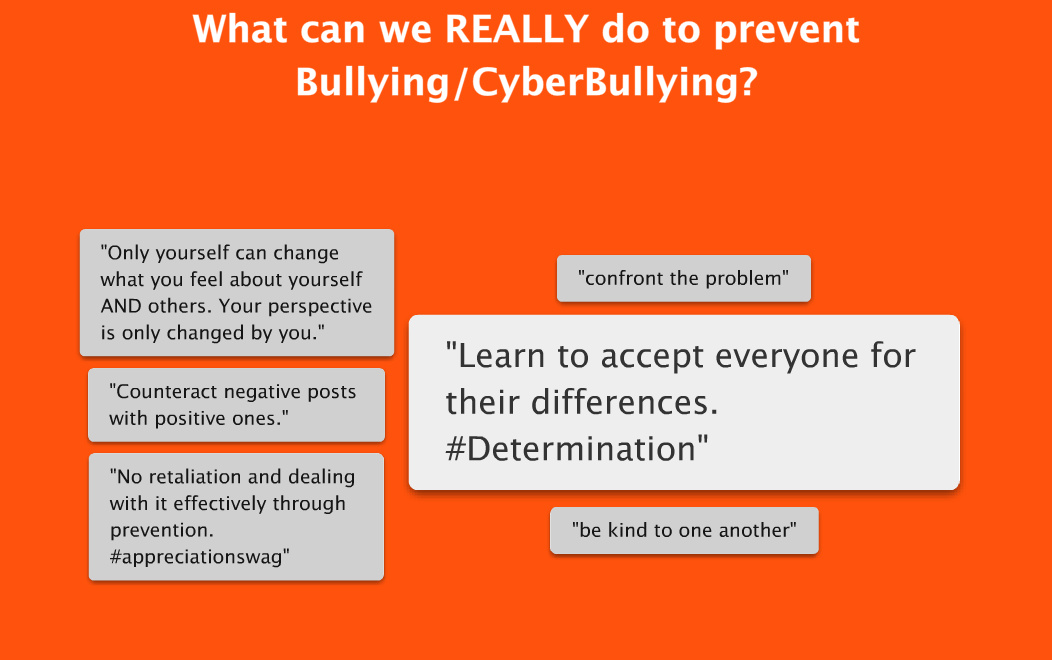
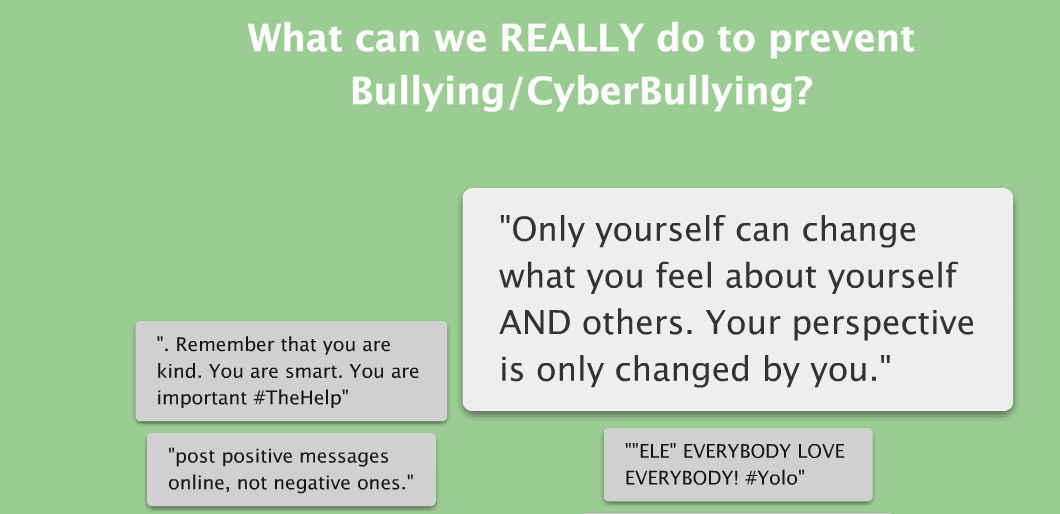
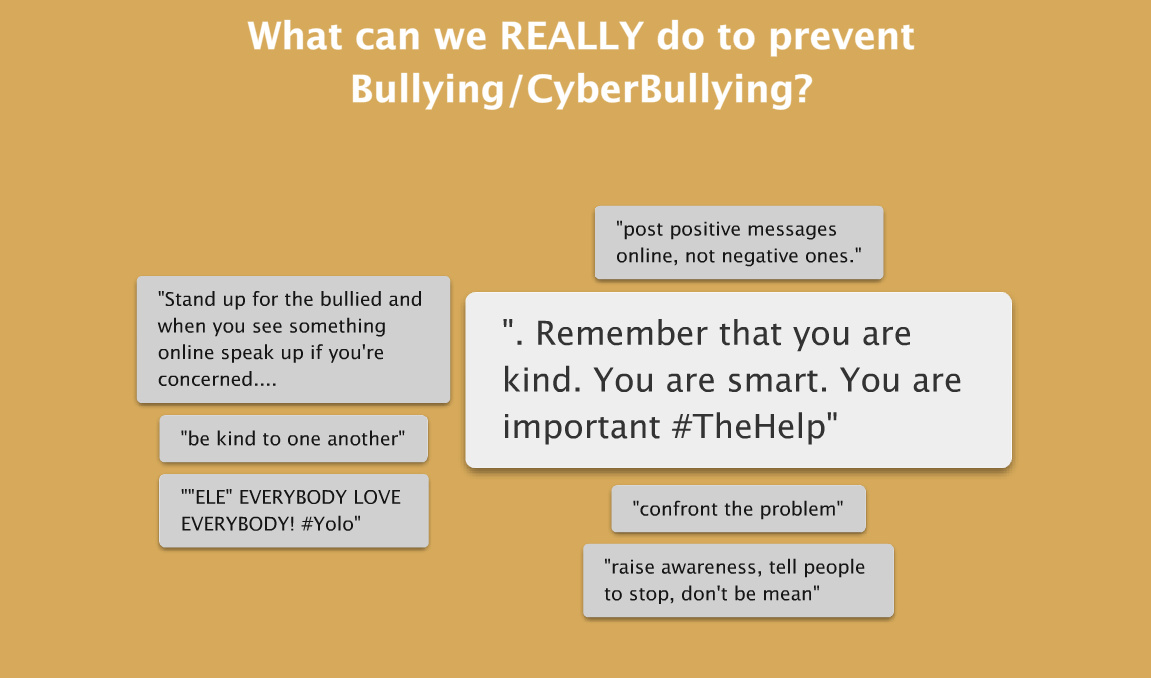
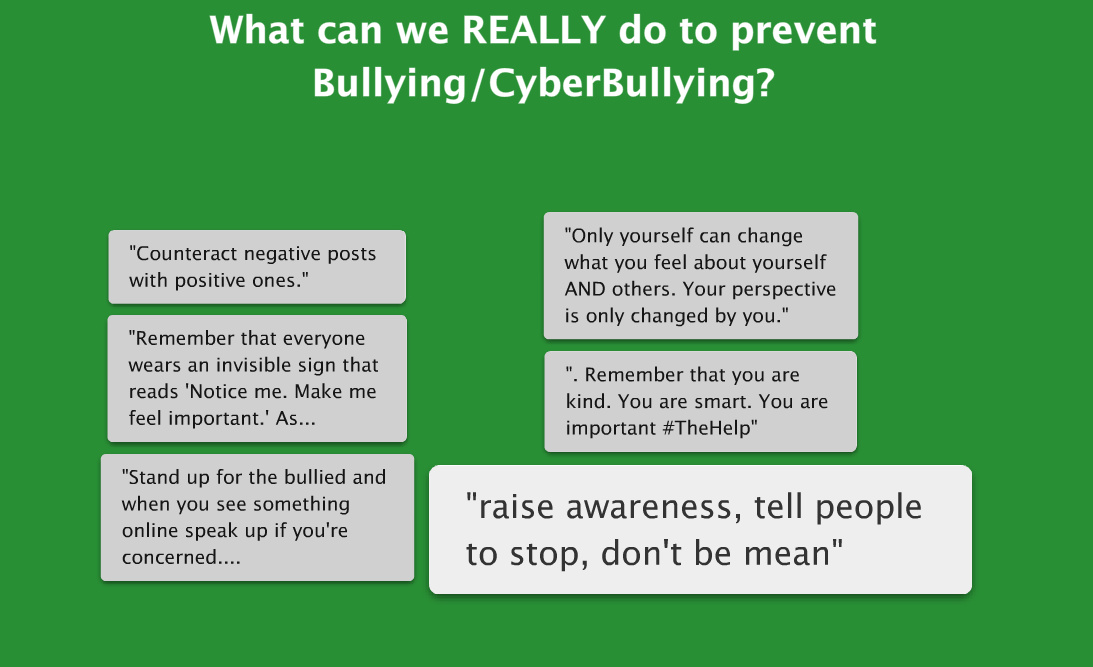
During the time I had with students, I asked them contribute their own thoughts about how to end cyberbullying, and this is what they shared (captured from PollEverywhere.com’s awesome service!):


There was a lot of wisdom in that room.
During the presentation, I also had the students stand up and repeat the You Matter Manifesto, from Angela Maiers, a colleague of mine’s work. I had the students say:
“I Matter.
I am a genius.
The world needs my contribution.”
I also added, “I need the contributions of others.”
I showed students a clip of the new Bully movie and asked them to consider how much they matter, how much others matter to them, and how supportive we can be in understanding that we all have contributions to make to the world.
150 10th Graders from all over Western New York participated in this.
150 10th Graders are taking the “You Matter” mantra back to their schools.
150 10th Graders inspired me this weekend.
I am so impressed with these young people. They matter big time!
I so appreciate the opportunity to get to work with them again!
*Jamey Rodemeyer was a 14 year old boy from Williamsville, NY, just miles from where I live, who took his own life in the face of bullying at school. Read More about him here.
Mike on Twitter
10th Grade student leaders came together at the University of Rochester to participate in team building and leadership building opportunities. This is the second year I’ve participated as a volunteer and I am so impressed with these young people.
This year’s message had an underlying theme of doing what’s best for others and featured opportunities to support collaboration, communication, and attending to the need to end bullying. The Born This Way foundation was there, as were Jamey Rodemeyer’s parents*, and I had the opportunity to speak to students about how they interact with Social Media, and considerations for what happens with Cyberbullying.
During the time I had with students, I asked them contribute their own thoughts about how to end cyberbullying, and this is what they shared (captured from PollEverywhere.com’s awesome service!):
There was a lot of wisdom in that room.
During the presentation, I also had the students stand up and repeat the You Matter Manifesto, from Angela Maiers, a colleague of mine’s work. I had the students say:
“I Matter.
I am a genius.
The world needs my contribution.”
I also added, “I need the contributions of others.”
I showed students a clip of the new Bully movie and asked them to consider how much they matter, how much others matter to them, and how supportive we can be in understanding that we all have contributions to make to the world.
150 10th Graders from all over Western New York participated in this.
150 10th Graders are taking the “You Matter” mantra back to their schools.
150 10th Graders inspired me this weekend.
I am so impressed with these young people. They matter big time!
I so appreciate the opportunity to get to work with them again!
*Jamey Rodemeyer was a 14 year old boy from Williamsville, NY, just miles from where I live, who took his own life in the face of bullying at school. Read More about him here.
Mike on Twitter
Wednesday, May 30, 2012
AnnoTango
A few weeks ago, I published a collaborative blog post on “Annotexting,” which involved the close reading of text, annotations of text, and evidence based reading practices but involving 21st Century technologies and web tools.
This week, I’d like to offer an update, or perhaps a companion, that I’m calling “AnnoTango!”
Annotexting still relies on a balance between what is teacher-led and what is student-driven. A teacher would still be “directing traffic” in a specific way as they utilize web tools and focus students on deep reading, finding evidence for claims, and drawing conclusions.
Once the Annotexting becomes part of the habitual way in which students read text closely, it’s time to shake it up, and let the dance begin!
This involves shifting more responsibility to the students and thinking of the learning process as a ballroom dance. Read. Annotate. Learn. Switch. Read. Annotate. Learn. Switch. The teacher is still the in-room coach, but the students take on the responsibility of collaborative and communicative learning in a web-enhanced but still Socrative way.
This is the “AnnoTango.”
The students read and annotate (with web tools!) and they begin processing what they are learning with a partner or small group. When the students switch, they “annotate their annotations,” deconstructing and reconstructing their thinking as they switch groups. All of the collective information is curated in the web tools that they are using as a demonstration of understanding. (In fact, you could use the web tools to collect the entire conversation rather than just the annotations or singular thoughts.)
The assessment of their work could be around the thoughtful analysis of a new work, the defense of their thinking around what they curated alone and in groups, or even a collaborative creation that demonstrates how this level of access to information and its analysis by the group leads to critical thinking and strong conclusions drawn about a claim or thesis statement. (based on collected and discussed evidence.)
I’d also like to add that a natural extension to this would be taking it global. (Common Core College and Career Capacity #7!) If the students are already using web tools, then inviting in another classroom or students anywhere in the world would be pretty easy, as long as you know where to connect to these students. Around the World with 80 Schools and Skype In The Classroom would be a good place to find those connections.
Also of note: Skype In the Classroom, just this morning, shared the “collections” area of their website that represented exceptional “Skype In The Classroom” projects worldwide: http://education.skype.com/collections
So that’s the “AnnoTango” in a nutshell. It can be an extension of “AnnoTexting” or a stand-alone way to let the close reading of text be more student-driven. The next step? I think David Bowie says it best in his late 80’s hit:
“Let’s Dance!”
Mike on Twitter
...
This week, I’d like to offer an update, or perhaps a companion, that I’m calling “AnnoTango!”
Annotexting still relies on a balance between what is teacher-led and what is student-driven. A teacher would still be “directing traffic” in a specific way as they utilize web tools and focus students on deep reading, finding evidence for claims, and drawing conclusions.
Once the Annotexting becomes part of the habitual way in which students read text closely, it’s time to shake it up, and let the dance begin!
This involves shifting more responsibility to the students and thinking of the learning process as a ballroom dance. Read. Annotate. Learn. Switch. Read. Annotate. Learn. Switch. The teacher is still the in-room coach, but the students take on the responsibility of collaborative and communicative learning in a web-enhanced but still Socrative way.
This is the “AnnoTango.”
The students read and annotate (with web tools!) and they begin processing what they are learning with a partner or small group. When the students switch, they “annotate their annotations,” deconstructing and reconstructing their thinking as they switch groups. All of the collective information is curated in the web tools that they are using as a demonstration of understanding. (In fact, you could use the web tools to collect the entire conversation rather than just the annotations or singular thoughts.)
The assessment of their work could be around the thoughtful analysis of a new work, the defense of their thinking around what they curated alone and in groups, or even a collaborative creation that demonstrates how this level of access to information and its analysis by the group leads to critical thinking and strong conclusions drawn about a claim or thesis statement. (based on collected and discussed evidence.)
I’d also like to add that a natural extension to this would be taking it global. (Common Core College and Career Capacity #7!) If the students are already using web tools, then inviting in another classroom or students anywhere in the world would be pretty easy, as long as you know where to connect to these students. Around the World with 80 Schools and Skype In The Classroom would be a good place to find those connections.
Also of note: Skype In the Classroom, just this morning, shared the “collections” area of their website that represented exceptional “Skype In The Classroom” projects worldwide: http://education.skype.com/collections
So that’s the “AnnoTango” in a nutshell. It can be an extension of “AnnoTexting” or a stand-alone way to let the close reading of text be more student-driven. The next step? I think David Bowie says it best in his late 80’s hit:
“Let’s Dance!”
Mike on Twitter
...
Thursday, May 3, 2012
Strategic and Capable
Choices.
Kids need access to choices in instruction so that when the moment arises they can make discerning decisions about what they will do.
I just watched that happen. At a conference with adults where kids were invited.
I just watched magic happen.
Heidi Hayes Jacobs keynoted at edJEWcon in Jacksonville, Florida this week to a national group of participants from Jewish Day Schools. The keynote was attended by over 200 people and included several dozen middle school students.
Heidi engaged the backchannel, the background conversation, during her keynote so that the information wasn’t just being delivered, it was being nuanced and discussed and explored to greater depths. This is the 21st Century dialogue symphony. Everyone is an instrumental piece of the orchestra and collectively creates an interactive performance.
Heidi used a web tool, Today’s Meet, to collect the backchannel as an “in the room” conversation. Additionally, the #edJEWcon hashtag was used on Twitter to capture the “out to the world” conversation.
Heidi hit a snag though, when she went to create the Today’s Meet room in the moment, during the keynote. The “EdJEWcon” room had already been taken.
By the students in the room.
On their own, they created their own backchannel so that they could capture the conversation and interact around the message they were receiving. This tool was already in their toolbox, and they made a decision in the moment to do their thing. Isn’t that cool?
This is precisely what it means for students to use the Internet and digital media strategically and capably. They had choices and they made a decision. They used it the right way and it was the exact right tool for the task. (Because the task is key, remember the Drill Slide!)
Here is a link to a transcript of the student room and their interactions.
Note the progression of cognition in the conversation. It started with the collection of soundbites and descriptions of the presentation. Then it segued to questions and then interaction and metacognition around Heidi’s message. So, so awesome.
Heidi had to create a separate room so that the entire audience could participate. What a great problem to have!
You can read the transcript of the whole group here.
Note that the adults jumped right into the interaction, sharing salutations and then responding to Heidi, each other, and the students who were dually participating in the whole group room.
I was so impressed by the way this worked. It invited everyone to be strategic and capable with the use of technology, specifically engaging strategies that help these students be college and career ready, and give educators examples of what this looks like in practice.
Big, big kudos to the middle school students at Martin J. Gottlieb Day School. You didn’t know it, but this was an assessment, one that happened in the moment but allowed you to prove your skills. You gave a performance, a recital of your capabilities...and you SHINED!
...
Kids need access to choices in instruction so that when the moment arises they can make discerning decisions about what they will do.
I just watched that happen. At a conference with adults where kids were invited.
I just watched magic happen.
Heidi Hayes Jacobs keynoted at edJEWcon in Jacksonville, Florida this week to a national group of participants from Jewish Day Schools. The keynote was attended by over 200 people and included several dozen middle school students.
Heidi engaged the backchannel, the background conversation, during her keynote so that the information wasn’t just being delivered, it was being nuanced and discussed and explored to greater depths. This is the 21st Century dialogue symphony. Everyone is an instrumental piece of the orchestra and collectively creates an interactive performance.
Heidi used a web tool, Today’s Meet, to collect the backchannel as an “in the room” conversation. Additionally, the #edJEWcon hashtag was used on Twitter to capture the “out to the world” conversation.
Heidi hit a snag though, when she went to create the Today’s Meet room in the moment, during the keynote. The “EdJEWcon” room had already been taken.
By the students in the room.
On their own, they created their own backchannel so that they could capture the conversation and interact around the message they were receiving. This tool was already in their toolbox, and they made a decision in the moment to do their thing. Isn’t that cool?
This is precisely what it means for students to use the Internet and digital media strategically and capably. They had choices and they made a decision. They used it the right way and it was the exact right tool for the task. (Because the task is key, remember the Drill Slide!)
Here is a link to a transcript of the student room and their interactions.
Note the progression of cognition in the conversation. It started with the collection of soundbites and descriptions of the presentation. Then it segued to questions and then interaction and metacognition around Heidi’s message. So, so awesome.
Heidi had to create a separate room so that the entire audience could participate. What a great problem to have!
You can read the transcript of the whole group here.
Note that the adults jumped right into the interaction, sharing salutations and then responding to Heidi, each other, and the students who were dually participating in the whole group room.
I was so impressed by the way this worked. It invited everyone to be strategic and capable with the use of technology, specifically engaging strategies that help these students be college and career ready, and give educators examples of what this looks like in practice.
Big, big kudos to the middle school students at Martin J. Gottlieb Day School. You didn’t know it, but this was an assessment, one that happened in the moment but allowed you to prove your skills. You gave a performance, a recital of your capabilities...and you SHINED!
...
Monday, April 23, 2012
Edupocalypse
It was too tempting to outright call this “Pineapple-Gate,” but I love that the issue of the ridiculous nature of assessment is getting attention. The stakeholders need to be discussing this and those in power need to be listening.
At issue specifically is the ridiculous testing practices that have been allowed to go on for years, collecting data that is skewed to this result or another, depending on what is chosen for inclusion or exclusion, and how we ultimately measure student learning - something that may or may not be as quantifiable as we think. Just a simple Google search for “How do we measure student learning?” offers results around measuring objectives, Bloom’s, or achievement. Not learning.
How do we know for sure that learning has occurred? And how do we know specifically what a teacher’s impact is?
In New York State, English Language Arts testing was last week, and even the students knew something was amiss. THE NEW YORK TIMES published an article about the testing situation with metaphorical pineapple drama (Pineapples don’t have sleeves!) and a NEW YORK CITY PRINCIPAL chimed in with her assessment of the situation.
What I think is pretty cool is that the students are proficient enough to assess the assessment. What might that say about student learning?
With many states upping the ante for not only more rigorous assessment and more frequent assessment, we are presenting the idea to students that learning = testing. If you don’t have to prove it, why attempt to learn it?
Don’t get me wrong, I’m not against standardized assessment. When I go to the doctor and he checks my cholesterol--I want that normed against what is acceptably healthy. I’m not a winner with a higher number! Likewise for blood pressure and weight. During the assessment of my health, I want there to be conversation and if a specific diagnosis is required, I want differentiated (more specific) assessments based on the information that was gathered.
But we don’t treat education in the same diagnostic way. It’s one size fits all.
There’s a funny cartoon making the rounds on Facebook and Twitter recently that speaks to this, asking a DIVERSE GROUP OF ANIMALS to participate in the same assessment. (noted that there is NOT a pineapple in the mix...)
What’s really happening is more about keeping federal Race to the Top Money than it is kids.
The fact is, systemic change takes time.
Education itself, even outside of current assessment practices, has needed an overhaul for awhile. It seems of late that the necessary upgrades and changes that are swiftly being (somewhat thoughtlessly) implemented are “good for the masses,” but it also feels like, to quote Elton John, “a bullet in the gun of Robert Ford.”
Is what we’re doing a brave and courageous thing with Race to the Top? Or is this just an attempt at cherry picking the best of what we think will work and piling it on top of an old system? That is never going to work.
Our “application today, better tomorrow” mentality is seriously flawed, and I have a feeling that things are going to implode if we don’t address some major inconsistencies in the successes we’re planning. Implode on an Apocalyptic level. It starts today with ridiculous pineapple test questions, and tomorrow--the whole system could fall apart.
I’m sure there are more things to consider, and would welcome anyone reading this to add to the list, but these are some of the major issues that I’m seeing in real schools across our country, even in states that have received millions of RTTT dollars:
We are not necessarily heading to a better place. We are heading toward a standoff. It’s not okay to push through so much change with the expectation of lawsuits and compliance. It’s not okay to use the variability of “one moment in time” tests to determine student achievement or teacher effectiveness. It’s not okay to call all of this innovative when we are really just bolstering the traditional.
Real change means new forms and different ways of thinking. Growth should not be punitive.
We are dealing with the lives and learning of children. We need to make better decisions. (I say “we” to mitigate responsibility...but I mean State and Federal Governments!) Let the people start making decisions and not the money.
An Edupocalypse is imminent if we don’t start thinking forward.
At issue specifically is the ridiculous testing practices that have been allowed to go on for years, collecting data that is skewed to this result or another, depending on what is chosen for inclusion or exclusion, and how we ultimately measure student learning - something that may or may not be as quantifiable as we think. Just a simple Google search for “How do we measure student learning?” offers results around measuring objectives, Bloom’s, or achievement. Not learning.
How do we know for sure that learning has occurred? And how do we know specifically what a teacher’s impact is?
In New York State, English Language Arts testing was last week, and even the students knew something was amiss. THE NEW YORK TIMES published an article about the testing situation with metaphorical pineapple drama (Pineapples don’t have sleeves!) and a NEW YORK CITY PRINCIPAL chimed in with her assessment of the situation.
What I think is pretty cool is that the students are proficient enough to assess the assessment. What might that say about student learning?
With many states upping the ante for not only more rigorous assessment and more frequent assessment, we are presenting the idea to students that learning = testing. If you don’t have to prove it, why attempt to learn it?
Don’t get me wrong, I’m not against standardized assessment. When I go to the doctor and he checks my cholesterol--I want that normed against what is acceptably healthy. I’m not a winner with a higher number! Likewise for blood pressure and weight. During the assessment of my health, I want there to be conversation and if a specific diagnosis is required, I want differentiated (more specific) assessments based on the information that was gathered.
But we don’t treat education in the same diagnostic way. It’s one size fits all.
There’s a funny cartoon making the rounds on Facebook and Twitter recently that speaks to this, asking a DIVERSE GROUP OF ANIMALS to participate in the same assessment. (noted that there is NOT a pineapple in the mix...)
What’s really happening is more about keeping federal Race to the Top Money than it is kids.
The fact is, systemic change takes time.
Education itself, even outside of current assessment practices, has needed an overhaul for awhile. It seems of late that the necessary upgrades and changes that are swiftly being (somewhat thoughtlessly) implemented are “good for the masses,” but it also feels like, to quote Elton John, “a bullet in the gun of Robert Ford.”
Is what we’re doing a brave and courageous thing with Race to the Top? Or is this just an attempt at cherry picking the best of what we think will work and piling it on top of an old system? That is never going to work.
Our “application today, better tomorrow” mentality is seriously flawed, and I have a feeling that things are going to implode if we don’t address some major inconsistencies in the successes we’re planning. Implode on an Apocalyptic level. It starts today with ridiculous pineapple test questions, and tomorrow--the whole system could fall apart.
I’m sure there are more things to consider, and would welcome anyone reading this to add to the list, but these are some of the major issues that I’m seeing in real schools across our country, even in states that have received millions of RTTT dollars:
- the millions of dollars are going to less than well planned professional development that is frustrating schools and preventing them from systemic growth. The PD is creating a system of compliance instead. “Too much, too soon,” “dump and run,” and “drive by” are not great adjectives to describe what a lot of states are doing with their professional development. But that is how teachers and administrators feel.
- The money trail is leading not to children, programs, and teachers. It is leading to assessment vendors, online teacher evaluation programs, and brand new textbooks. (Textbooks which may address/reference the new standards, but hardly represent 21st Century mindsets or College and Career Readiness--many schools purchasing new textbooks would never in a million years consider a digital text.) Additionally, many of the “exemplar units” from states represent the awesomeness of 1981, not 2012.
- Teachers are being given the new standards and expected to unpack, translate, design, and implement around them with little time for the critical foundational pieces of collegial dialogue, collaboration, and consensus. (And perhaps, buy in?)
- Time is not being addressed. Time for curriculum work, time for deepening instructional design and practice, and time for planning and assessment are major roadblocks not being dealt with. This will be true for administrators too as they suddenly must deal with overwhelming and cumbersome teacher evaluation plans, while being instructional leaders, running their buildings, and navigating a daily schedule of the hundreds of little decisions that have to be made on a daily basis.
- The assessments are not really living up to the measurement of much beyond flawed teacher evaluation systems and a misalignment of priorities around what students know and are able to do. If it were me--those students that identified some of the flaws in the recent NY state test should get honorary mastery level scores. Beyond answering those flawed pineapple questions correctly, what else says “learning has occurred” like a demonstration of the deconstruction of the validity of the test. By kids.
We are not necessarily heading to a better place. We are heading toward a standoff. It’s not okay to push through so much change with the expectation of lawsuits and compliance. It’s not okay to use the variability of “one moment in time” tests to determine student achievement or teacher effectiveness. It’s not okay to call all of this innovative when we are really just bolstering the traditional.
Real change means new forms and different ways of thinking. Growth should not be punitive.
We are dealing with the lives and learning of children. We need to make better decisions. (I say “we” to mitigate responsibility...but I mean State and Federal Governments!) Let the people start making decisions and not the money.
An Edupocalypse is imminent if we don’t start thinking forward.
Saturday, April 7, 2012
Leverage The Web for the Common Core!
Are your students consumers of information? Collectors of information? Contributors of information? Cognitive about information? Learn how web tools can help students become content curators, collectors of information with purpose and discernment, and how these lead to supporting the Common Core.
The archive of the live event is below, hosted by LiveBinders and the Knowledge Sharing Place.
In this webinar, we will explore web tools, including LiveBinders, and some examples that exemplify what content curation looks like, so that your students can begin to think in new ways and extend their learning to College and Career Readiness!
More on Curation and integrating 21st Century Tools can be found on Curriculum21's WEBINAR SERIES PAGE.
Thursday, April 5, 2012
Storybird Awesomeness...
Any of the folks that follow me regularly know that I already have a very deep love for Storybird.com.
In the last few months, the company has been putting pieces into place to deepen that love a lot. A whole lot. Teachers need to pay attention here, big time! While there are a lot of free tools on the internet, there's a lot of tools that offer super mega upgrades for minimal prices. Storybird has stepped into that zone with a paid version of their product for teachers.
Low cost and high return have always been friends in my book, and Storybird has created a low cost option of awesome with mega levels of return. I remember talking with the higher ups there a year or so ago about the realities of the economy and what teachers/districts could really afford to spend. They've totally hit a home run with their paid upgrade--I'm so impressed I'm blogging about it!
Those of you that have been in workshops with me have likely already seen what the PDF download looks like on my iPad. I've probably also shown you the printed out books from Storybird. In this age of digital devices and anytime accessibility, the digital download is where it's at, and at 34 cents apiece, you can't beat it. Storybird's options for teachers include a plan that's roughly a hundred bucks, but gives you up to 300 PDF downloads and a slew of other options including grading, student accounts, and multiple class tools.
Their service just keeps getting more and more awesome and because it's based on writing, I'm using it a lot in my work with teachers around Common Core implementations. Using the service forces some of the College and Career Readiness capacities such as attending to different audiences, tasks, purposes, and disciplines. It also demands that students be discerning in their use of the technology and offers opportunities for global conversations and interaction.
Students could use it to write narrative works, persuasive and argumentative pieces and informational text, all situated with stunning visuals and an easy to use editor that most kids can master in seconds.
If you're interested, here are my previous posts on Storybird. I just can't say enough good about them. I can say though that I've got to run--I'm playing on Storybird the rest of the evening!
New on Storybird!
Exciting Storybird News!
Storybird for Christmas...
So Easy, A Grownup Can Do It
...
In the last few months, the company has been putting pieces into place to deepen that love a lot. A whole lot. Teachers need to pay attention here, big time! While there are a lot of free tools on the internet, there's a lot of tools that offer super mega upgrades for minimal prices. Storybird has stepped into that zone with a paid version of their product for teachers.
Low cost and high return have always been friends in my book, and Storybird has created a low cost option of awesome with mega levels of return. I remember talking with the higher ups there a year or so ago about the realities of the economy and what teachers/districts could really afford to spend. They've totally hit a home run with their paid upgrade--I'm so impressed I'm blogging about it!
Those of you that have been in workshops with me have likely already seen what the PDF download looks like on my iPad. I've probably also shown you the printed out books from Storybird. In this age of digital devices and anytime accessibility, the digital download is where it's at, and at 34 cents apiece, you can't beat it. Storybird's options for teachers include a plan that's roughly a hundred bucks, but gives you up to 300 PDF downloads and a slew of other options including grading, student accounts, and multiple class tools.
Their service just keeps getting more and more awesome and because it's based on writing, I'm using it a lot in my work with teachers around Common Core implementations. Using the service forces some of the College and Career Readiness capacities such as attending to different audiences, tasks, purposes, and disciplines. It also demands that students be discerning in their use of the technology and offers opportunities for global conversations and interaction.
Students could use it to write narrative works, persuasive and argumentative pieces and informational text, all situated with stunning visuals and an easy to use editor that most kids can master in seconds.
If you're interested, here are my previous posts on Storybird. I just can't say enough good about them. I can say though that I've got to run--I'm playing on Storybird the rest of the evening!
New on Storybird!
Exciting Storybird News!
Storybird for Christmas...
So Easy, A Grownup Can Do It
...
Wednesday, March 21, 2012
Teacher Appreciation Day in May
Teacher Appreciation Day is rapidly approaching the week of May 7-12.
From Teacher-Appreciation.info:
- "Teacher Day is a remarkable occasion for all of us to show our teacher appreciation, whether we are students or we wish to compliment a former teacher, or our kids’ teachers."
More than any other time in my career as an educator, I feel that teachers should be lifted up and celebrated. This year, for teachers across the country, has been a harrowing one. They are responsible for new standards, new forms of data driven instruction, articulating specifically the connections between instruction and assessment, new teacher evaluations, and more! Oh, and they also have TEACH THE KIDS IN THEIR CLASSROOMS!
Much of what teachers do goes unnoticed, because much of it happens outside of school. Teachers put in their 8 hours, and then many work as much as 4 or 5 hours more when they get home: writing detailed lessons, planning for future instruction, grading papers, evaluating writing, and more. Teachers today also have roles beyond the ones that outline their jobs: they are sometimes parents, counselors, coaches, and they may be the only smile a child sees all day.
Teachers are one of our most important national treasures. With the spotlight that is currently on the entire profession and the microscope under which all educators work, it is important to continue to let them know how appreciative we are that they do the jobs they do. Without them, we'd have no doctors, no lawyers, no presidents, no anything. Teachers prepare kids for the world and the second week in May is good time for the world to show some love.
If you or your school or your local PTA is interested, a friend in Georgia is sponsoring a national campaign to unite teachers in "appreciation solidarity!" Please click here to visit For Educator's Only, for more information about you can show your appreciation to a teacher this year!
Wednesday, February 29, 2012
ANNOTEXTING
The companion LIVEBINDER OF INTERACTIVE TOOLS IS HERE.
Expecting students to read deeply and draw meaningful conclusions is at the heart of the Common Core ELA standards. Students are asked to read closely, cite evidence, and make evidence based inferences when they read. They are expected to deepen their learning by valuing textual evidence and reading critically. Annotating text is one way students can cite textual evidence, infer and deepen meaning as they read..
Annotations make thinking visible for teachers and students. We can use the words and features of a text to better comprehend it, ask questions, and note our thoughts while reading. One goal of comprehension is that students will be proficient annotators of texts to understand more deeply by interacting and making thinking transparent while they read.
There are many reasons to ask students to annotate text: for basic comprehension, to show evidence of conceptual understanding, to show what is implied, to identify the claims in an argument, to read like a writer and identify characteristics of genre, to notice the nuance of language...and many other reasons. Giving guidance as to what we want students to annotate for will be beneficial for the reader. Otherwise, they will annotate everything that comes to mind, and the work may not be helpful to the reader or the teacher.
Annotations are often a singular, individual experience. Annotexting ups the ante all around.
Annotexting is a process that involves the collection of thoughts, observations and reactions to reading that show evidence of critical thought. These annotations, rather than being on paper, can be collected with different web tools so that students can collaborate, both locally and globally, around the conclusions that they will ultimately draw from their reading.
Students submit their annotations via their smart phones or other digital devices, and then analyze each other’s notations collectively. They could be looking for main ideas, thematic and literary elements, or big ideas from the work. They could be looking for evidence of connections to other texts, their own experiences, or world issues. They could simply be searching for meaning to support them when reading complex texts.
In addition, students could reflect on the collective evidence as a metacognitive activity to assess their own learning. Perhaps the collaborative exercise raised new questions for them or offered them new ways of thinking about the text. Perhaps there is something else the student wants or needs to know?
Metacognition can be strengthened when citing evidence in text. Textual evidence that supports the thinking behind what they are thinking is a gigantic first step into the depth and complexity that the Common Core is asking of students. Annotexting kicks that up a notch by engaging task specific tools that offer opportunities for strategic thinking and globally connected opportunities.
Consider THIS ANNOTATED TEXT.
The student wrote all over this poem. The student underlined specific words and wrote annotations about them in line with the text. This student is engaging in a thoughtful, albeit singular, analysis of this poem.
What changes with multiple perspectives?
We have our own ideas about squat pens and writing utensils as weapons (based on the student’s annotations) but they are different than this student’s collection of evidence. What would have changed in the interpretation of this poem if our perspectives were woven together? Does the collaborative process of conversation yield a greater product? Does the thinking extend when multiple perspectives are mixed? Does the evidence yield to strategic thinking when multiple viewpoints are involved?
Besides the strategic and capable use of digital tools, annotexting offers students the opportunity to value evidence, think critically and engage with different perspectives. Rather than working independently to read, comprehend and analyze text, annotexting will allow students to engage with other audiences in tasks with an expanded purpose, supporting college and career readiness.
We’ve created an example of what this could look like in Corkboard using William Blake’s poem, “The Tyger.” (Click on the Corkboard tab in the Livebinder. The example is in a subtab.) You can see other examples in several of the tabs in the binder. We would also like to share this DISCUSSION RUBRIC (2007) that you can use as students submit annotations and begin to draw conclusions about what their evidence is pointing to.
In order to get students to own this process, we have to relinquish some control. Let them think, let them make mistakes and respond. Let them draw conclusions even they are not the conclusions we would have drawn. We can be there to coach them through misconceptions.
The college and career ready student (on page seven of the ELA Common Core document) is expected to attend to audience, task, purpose and discipline in both reading and writing. The standards also expect students to think critically and value evidence. The document goes on to explain that the college and career ready student should use digital media strategically and purposefully. Annotexting is at the intersection of all of these capacities.
In addition to collecting evidence with web tools, there are also digital APPS that we’ve come across that would work for Annotexting too. (These are represented in the LiveBinder as well.) Some are notetaking apps that let you collect evidence and annotations with a digital device and some let you edit and annotate PDF files and documents. There are resources in the binder for both iTunes and Android Market Apps.
Some Youtube tutorials for a few of the tools referenced in the binder:
GoodReader app
http://www.youtube.com/watch?v=TIrBS8d_CCA
PaperPort (this one's free) it let's me import my pdf files...and annotate them!
http://www.youtube.com/watch?v=6Yu1Fg4xu9E
Note Shelf- for notetaking
http://www.youtube.com/watch?v=0H7es6CkE8k&feature=related
iAnnotate
http://www.youtube.com/watch?v=KHoAGbQcp2o&feature=related
Phatpad
http://www.youtube.com/watch?v=t55Y6M-hriQ
If you would like to explore this and other Modern Learning moments more in depth, check out Curriculum21’s Webinar Series and our all new LEAD21 Academy at this year’s Curriculum Mapping Institute. We will also be exploring the Common Core as it relates to Curriculum Design at the upcoming Ohio Regional Conference in May. (Space is limited!)
Fisher, Michael L., Jr. and Nancy Cook. "Notice, Think, and Wonder: New Pathways to Engage Critical Thinking." IN TRANSITION: Journal of the New York State Middle School Association. 25.1 (2007): 15-18. Web. 25 Feb. 2012.
Follow Mike on Twitter
Follow Jeanne on Twitter
Follow Curriculum21 on Twitter
...
Subscribe to:
Posts (Atom)