Sunday, September 23, 2012

Assessment Priorities: Advancing Curriculum Mapping

'The Great Wall' photo (c) 2005, moniqca - license: http://creativecommons.org/licenses/by-nd/2.0/


Assessment is the cornerstone of all curriculum design.

When we begin with the end in mind, a la Jay McTighe’s and Grant Wiggin’s work in Understanding by Design, we set a path for success focused on a target. (Read Chapter 11--it’s an eye opener!)

Some of you may remember how the Triple A company used to prepare Travel Triptiks for customers in a pre-Google Map world. Triptiks were a trip planning tool that were designed with the destination in mind. As you traveled from your current location to your intended destination, you were given different routes, points of interest, and drop-in suggested side trips that would enhance your journey while still achieving your desired destination. In order to create the Triptik, though, you had to identify the destination. Otherwise, how would you plan your trip?

I think of these often when I think about curriculum. The assessment is our destination. Our path is the Triptik. Side trips are awesome, different points of interest are engaging, and we don’t have to travel the same linear path as everyone else.

The problems arise when we know our destination, but travel to other places instead. For instance, if I lived in Jacksonville, Florida and wanted to travel to San Antonio, Texas; I wouldn’t stop in Chicago first. I’m sure that comparison is clear enough, but it’s not so neat when we think about curriculum design. Whatever our objective is, depending on the standards we are addressing, it is dependent on the instruction we offer to our students. If an assessment asks students to evaluate and create but our instruction asks only that they remember and comprehend, then we’ve taken a wrong direction somewhere and end up in a swamp of learning limbo.

So how to remedy the opposite of symbiotic planning? Think cognition. Think purpose. Think of how you’re going to ask kids to prove what they’ve learned.

Most of the states in the country are aligning instruction and assessment to the Common Core. In the course of upgrading curriculum and/or curriculum maps, many are paying attention to the instructional elements but not necessarily the assessment elements.

In a recent conversation with second grade teachers, I discovered that students were really falling down on the common assessments that the teachers were using in math. I asked the teachers what they thought was going on. Some responded that the students were just lazy and others thought that the tests were just too hard. I asked them if they had really looked at the test questions. I asked them if they were teaching the skills that the students would need to answer the questions successfully. I asked if the skills to answer the questions correctly were part of their “planned-for” instruction and whether or not they were represented in their curriculum maps.

They weren’t sure. So, question by question, we broke down the skills a student would need to answer a particular question correctly. What we discovered was that those skills aren't necessarily being taught. It was an uncomfortable conversation, but the teachers were using worksheets that came with their math textbooks, as they always had, and using assessments that represented the standards and were created by the teachers. There was a mismatch. The rigor of the instruction rarely matched the rigor of the assessment.

I have to admit, there were some tears in that workshop. The reliance on the worksheets and the assumption that they were building fluency were flawed. They were preparing kids for Chicago, but not San Antonio.

In order to impact learning, we have to be cognizant of and plan for the intricacies of curriculum symbiosis. That means that instruction and assessment must have a high degree of parallelism in terms of levels of cognition, types of activities, individual student priorities, content, etc. Our main curriculum priority upgrade focus, then, must be assessments. I know some may read this and see the message: “teach to the test.” Just to clarify, that is NOT what I’m saying here. What I’m advocating for is to teach FOR the test. If instruction prepares students well, then the assessment will be a true measure of learning versus a hope and a prayer that students “get it.”

In our upcoming ASCD book, Upgrade Your Curriculum: Practical Ways to Transform Units and Engage Students, (Tentative Feb. 2013) Janet Hale and I discuss assessment as an entry level to transforming instructional design and practice. This includes the examination of curriculum, assessments, instruction of the future versus instruction of the past, and more. We recently found out, as planned in the writing of the book, that we will be able to leverage ASCD Edge to amplify the book and have interactive moments between us and our readers.

This interactive/social element will be coming in mid-January / early February just before the book is to be published. In the meantime, we’ll be blogging about the elements of the upgrades and transformations that we are describing in the book. With this post, and our previous post on “Planting A Seed,” we will be looking at advancing curriculum design and practice as well as share additional examples of Upgrades and Transformations from the field.


Cure for the Common Core eBook now available.
...

Sunday, September 9, 2012

3 Tips To Communicate More Effectively Via Social Media


Guest Post from my friend and colleague, Bena Kallick...
Bena Kallick, Eduplanet21
Are you having trouble listening with understanding and empathy (one of the Habits of Mind) when you are not face to face with the other person–on facebook, Google+, twitter, or other social networks?  As an educator, staying in touch with your professional learning network digitally is a boon to the quantity of communication, but without the proper habits, you may not be reaping the quality you might.
Inspired by the thinking from my work with Art Costa at the Institute for the Habits of Mind, here are some tips:
1. Pause
Do you find it hard to manage your impulsivity? Do you want to just respond, like, or share and get it done to move on to the next task? This diminishes the quality and substance of your interactions. As you pause, prioritize the messages that you value most and send them in an order that allows you to invest the appropriate focus on each one.
We are all captive to this experience so when you find yourself engaged in an important issue with someone else–on another network, or in person, minimize the browser window, or even get up from the computer altogether to help shift cognitive “maps,” then return to the computer when you have some time. This would be equivalent to the pause button that we use when we are engaged with someone face to face.
2. Paraphrase
It is often the case that we think we understand what another person is saying and we jump to conclusions without checking to see if we truly understand. Paraphrasing is a very useful tool when in a web based conference. For example, when there are many people communicating at once–in-person, on a conference call, or even on a social media platform–it helps to paraphrase what you understand are the key points.
At the same time, you are helping to summarize and make sense out of the multiple perspectives, an important thinking and communication skill. This also reduces the temptation to simply get your .02 in without respecting the topic or purpose of others involved in the communication.
3. Probe
Good questions serve to clarify as well as extend the communication and the thinking. Especially with social learning, good questions are the start for good feedback. Probing what the other is saying shows respect for the other person’s thinking, and a curiosity about how that thinking might influence yours.
Why is this so important? Most people are living at least one half of their professional life in social learning or communication of one sort or another.
How do you use–or fail to use–thinking and communication habits (Habits of Mind, for example) as a guide for making your work in education meaningful?
Image attribution flickr users tanyaalittle and nostraimago
Bena Kallick

Bena Kallick

Bena Kallick is well known for her work in curriculum, instruction and assessment with an organizational focus on change. Her publications with a focus on thinking and the habits of mind include: Assessment in the Learning Organization, Assessment Strategies for Self-Directed Learning, Learning and Leading with Habits of Mind, and Habits of Mind Across the Curriculum (all co-authored with Art Costa). She currently works with Eduplanet21.

Friday, September 7, 2012

Power to the Students: Why Educators Need to Pay Attention to Student Discontent


This blog post is being simultaneously published with a companion piece on ASCD Edge, which you can read here. In it, Allison Zmuda interviews the subject of this blog post for additional insight into giving Power To The Students...

'Student Protest: Liverpool Walkout' photo (c) 2010, Matt Baldry - license: http://creativecommons.org/licenses/by/2.0/

Meet Nikhil Goyal, a seventeen-year old high school senior: http://nikhilgoyal.me/

Nikhil has written a new book, One Size Does Not Fit All, a call to arms to the educational community that provocates with the voices that matter the most: students. Despite all of the political rhetoric and haggling in the press about one side or the other’s best intentions for students, it’s really the students that have the most to lose if we don’t get this right, and the most to gain if we do. In order to do the best we can for the next generation, we need to make them part of the process.
  • How often do we ask students their opinion about what they want to learn? How they want to learn it?
  • How often do we give them a real audience for their work? How often do we give regular, action-oriented feedback so students can improve their work because of their target audience?

Nikhil, in writing his book, has interviewed hundreds of peers, policy makers, and forward thinkers such as Howard Gardner, Seth Godin, Dan Pink, Noam Chomsky, and Diane Ravitch. In an effort to extend the message of Nikhil’s new book, we want to continue the collection of data around student perceptions of school and their school experience. Based on the data analysis, we can start making some real connections to intentional shifts and craft a plan of action around learning in the 21st Century.

We are asking our learning community to help us collect this data through a student engagement survey:  https://www.surveymonkey.com/s/juststartkidsurvey

Why should you encourage students to take the survey?
1. It demonstrates that you care about them.
2. It demonstrates that you want to design meaningful learning experiences for them.
3. It demonstrates that you also grow from feedback based on your target audience.

Why should students take the survey?
1. It demonstrates that what they say matters.
2. It demonstrates that their ideas can spark new innovations in their own classrooms as well as create movement in classrooms around the country and the world.
3. It demonstrates the power of individual contribution in service to a larger cause.

What’s in it for you?
With school starting back up, we want to engage as many students as possible in the data collection. In return, we will give continual updates through ASCD Edge and on our individual sites about what the data suggests in terms of upgrading the learning for all students.

Sometime in the next two weeks, we are looking to collect as many responses as possible from schools around the country. The more information we collect, the better the conclusions we can draw about innovations for modern learning design and practice.

Please Tweet, Blog, Share, Pin, Email, EduClip, whatever you can to help get the survey out! On his “ABOUT” page, Nikhil shares a quote from Seth Godin, “When enough of us act, the system will have no choice but to listen, emulate and rush to catch up.” It’s time to stand up and act decisively. We have a duty to our children to get this right or future generations will suffer tremendously from the status of our schools. A generation is a terrible thing to go to waste.

This blog post was collaboratively written by:
Mike Fisher, a prolific blogger, educational consultant, and author: digigogy.com
Allison Zmuda, an educational consultant, author, and proud creator of a new venture: just-startkidsandschools.com.

Follow Mike on Twitter: @fisher1000
Follow Allison on Twitter: @compclass
Follow Nikhil on Twitter: @nikhilgoya_l

Thursday, August 16, 2012

Math Modules, Learning Targets, and More!

Since I posted quite a few ELA resources yesterday, I thought I would post some math resources today.  There are several items here, including Karin Hess’s Learning Progressions for Math aligned with the Common Core and K-12 Learning Targets created by Carl Jones, Director of Curriculum for Darke County Educational Services in Ohio.

K-12 Learning Targets:

The K-8 Targets include Examples and an example of a possible assessment. Carl really did A LOT of awesome work here!


The 9-12 Learning Targets are from Kentucky’s Department of Education and include Learning Targets, but call them “Reasoning Targets.”


Learning Progressions from Karin Hess:


Cognitive Rigor Matrix by DOK level from Karin Hess:


CCSS Aligned Math Module Samples from other states:


Note that however you decide to start your alignment to the Common Core standards, these resources should be considered as just a piece of the standards-based pie. If you’ve not explored Learning Progressions or Learning Targets before, I know that it can be somewhat overwhelming--just with the sheer amount of information to consider.

If you’d like more information on Learning Targets, ASCD published a book last month about it WHICH YOU CAN FIND HERE.

As I find new stuff, I’ll come back and add it here!

Mike on Twitter

Wednesday, August 15, 2012

ELA Modules and Unit Planning Resources

I'm at a Network Team meeting in Albany New York this week with Educational Leaders and Teachers from across the state. The New York State education department is rolling out new curriculum modules aligned to the Common Core for grades PreK through 5. The link to the new stuff is here:

ENGAGENY resources for Curriculum Modules

This is intended to deepen classroom practice and improve student achievement by showing teachers new ways to teach.

I thought it would be a good idea to share some resources for HOW to go about designing modules and units as well:

ELA Template for Trimester-quarterly Modules


Update 10/19/12: The link to K-12 Learning Targets for ELA has changed. (It appears at the end of the embedded document.) PLEASE CLICK HERE to access new link.

If you build it, you will own it. If you own it, you will strive to make it better!

Good luck Network Team participants!

Mike on Twitter

Tuesday, August 7, 2012

Plant A Seed: Advancing Curriculum Mapping

In Mapping, Heidi Hayes Jacobs describes four phases that districts must go through in order to attain and sustain a systemic curriculum mapping initiative: Laying the foundation, Launching the process, Maintaining and Sustaining, and Advancing the work. (2010) In fact, I would say too that the four phases work for just about any curriculum endeavor you may have. It can be a full map or it can be a series of related units, lessons, anything. The point is to begin where you are and just start growing!

In a conversation recently with my colleague and friend, Janet Hale, we were discussing the thoughts behind the importance of vertical conversations in schools. These conversations are among multiple grade levels and entail conversing and learning about what students should know and be able to do from grade level to grade level. While vertical conversations may happen within a grade level or two above and/or below a particular teacher’s assigned grade level, they don’t often happen as easily with representatives from a full K-12 cadre of teachers.  With summer coming to an end and a new school year beginning, we thought it would be a good time to get the curriculum conversations started anew.

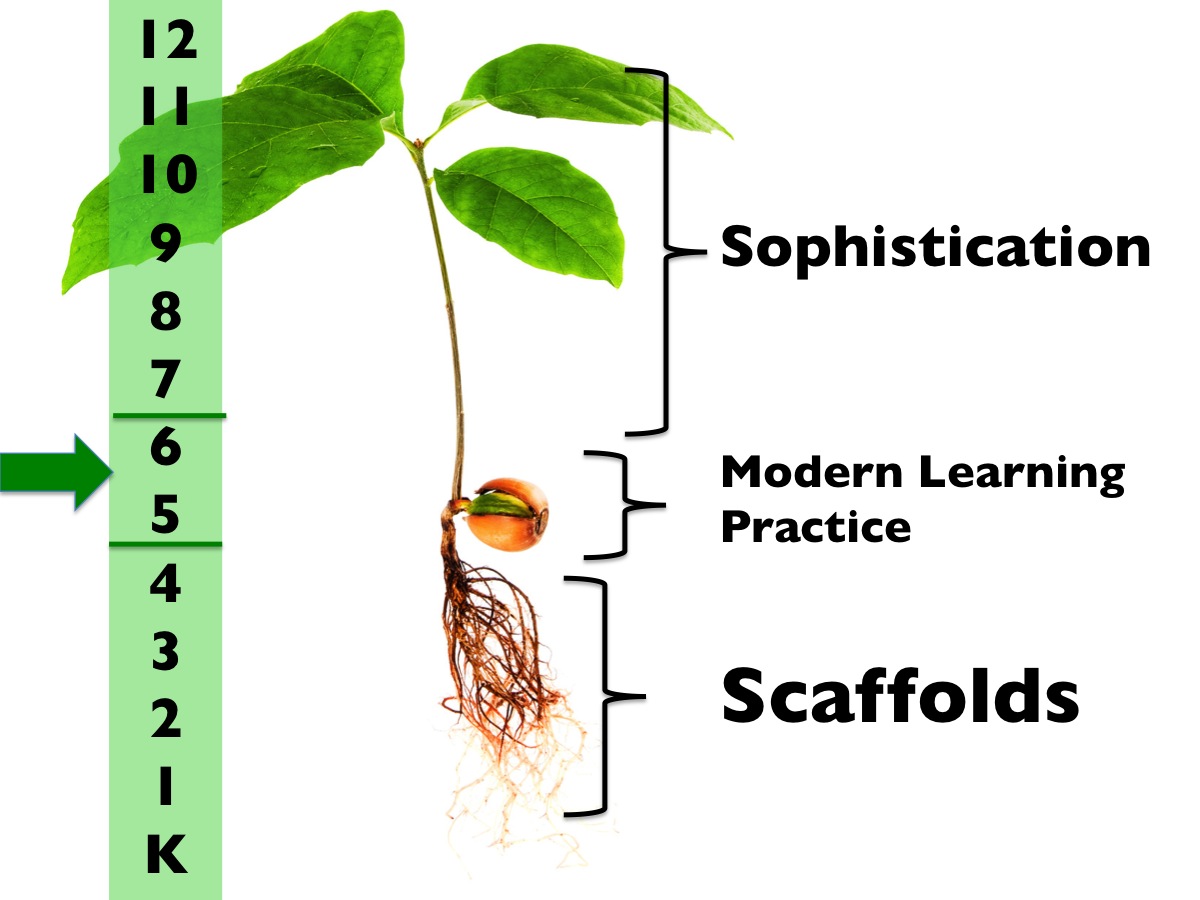
We thought a good way to spark these conversations would be to plant a seed of modern instructional practice.  (see Figure 1)


Figure 1


Once maps or units are in place, the impetus is upon us to keep them growing and evolving. We do that through continued collegial curricular conversations and through intentional actions to grow and modernize learning from instructional moment to instructional moment and from year to year. This could include conversations and actions around modern methodologies, modern tools, or the engagement of multiple modalities.

As an example, let’s think about the informative essay that students are always being required to do. Students pick a topic, find information on that topic, and right a five-paragraph essay with a complete beginning, middle, and end.

What if we planted a seed about what the modern informative essay might look like? We could brainstorm possible alternatives/modalities, whether or not it would even be on paper, and what web tools we might invite students to choose as they both researched and wrote. In Figure 1, I set the “seed” at the 5th or 6th grade level. (The seed could be set at any grade level, depending on the seed that is to be planted!) That is where the conversation would begin.

Then, we would need to consider some or all of the following:

  • What would a 5th or 6th grader need to be proficient in a modern way with researching, writing, and representing/presenting their informative creation?
  • What do we need to consider in terms of college and career readiness?
  • What of the total package of methodologies, tools, and modalities would we accept as evidence that students learned what we intended for them learn?
  • How would the teacher’s role in this scenario be minimized for the sake of student choice and voice to be maximized?

Next, we take the conversation vertical, to roots and blooms! In order to meet a particular level of proficiency by the time a student is in 5th or 6th grade, what must happen in earlier grades that grow the roots and foundations to prepare students for this new form of learning?

  • What does preparation look like in previous grade levels to scaffold the laying of the foundations of modern learning?
  • What do students in previous grade levels need to know and be able to do from one level to the next?
  • How is this scaffold and the seed represented in curriculum maps or in vertical unit plans from one grade level to the next?

When we get to the “bloom” (Bloom’s!!!) level, we are extending and sophisticating. As our students go beyond the seed, what do the levels of sophistication look like?

  • What is it that is higher level than the seed we planted?
  • How can we sophisticate the levels of methodology, tool, and modality as our students get older?
  • How deep can we go? How can we leverage the bloom to “uncover” learning while keeping student work student-centered?

If you’re looking for a way to breathe new life into your curriculum or into your mapping initiative, this is a good place to start. Continue the conversations. Continue considering the college and career student. Continue discussing scaffolding and sophistications around the seeds you’ll plant.

In the coming weeks, Janet and I will be sharing some examples of K-12 seeds we’ve planted, as well as the roots and blooms around them. Stay tuned!


Jacobs, H. H. (2010). Curriculum 21, essential education for a changing world. Alexandria, VA: Assn for Supervision & Curriculum.


Follow Mike on Twitter
Cure for the Common Core on Amazon Kindle

Saturday, July 14, 2012

Bully Mapping

There are times when I blog when I wonder about the consequences of what I “put out there” and how it may be perceived. There are also times when I feel like I’m getting thoughts out that may be incomplete or are in need of additional information. I try to explain to others about the nature of a blog not being a completist publication event. It is the spark, the impetus, if you will, for creating a conversation, not just the delivery of information. So please know, when I write what I’ve written here, it’s just that: a conversation starter. There are many implications and many holes to fill in, but the actions must begin.

...

I just read the most amazing blog post about bullying at summer camp and what one camp director did to begin to remedy the situation. YOU CAN READ THAT POST HERE.

One of the excellent ideas that the author wrote about was the concept of “sociograms.” The author describes them as “a social map of [a counselor’s] cabin twice per four-week session, to show which campers are ‘in’ and who’s being left out. On day five of each session, every camper fills out a questionnaire, which asks, among fun stuff like favorite activities, if anyone has made them feel unsafe.”

This resonated with me big time. This is a specific act that teachers can take to start curbing bullying at school. My mapping alarm went off. We can direct a path to our intended destination with just a few considerate and reflective moments of time.

When we map curriculum, we think first of evidence, then actions and tasks to get to that evidence. I think the same process would work for our work around antibullying efforts in schools.

This author gave me an idea that I’m calling RAP: Responsibilities, Actions, and Proof. (It relates to curriculum mapping: Content, Skills, Assessment.) If “RAP” is too convivial or contrived an acronym, use whatever you want to call it; but identify your action plan.

What are the Responsibilities around preventing bullying:

  • Conversation with students
  • Awareness of the outsiders
  • Monitoring of places where bullying could happen
  • Personal interactions
(Funny that those create an acronym: CAMP. That was the seed of this blog post!)

What are the Actions needed to stop bullying:
  • Knowing who the outsiders are and planning for specific actions to bring them in.
  • Keeping track of who is on the inside and who is on the outside.
  • Specifically addressing those who exclude others for any reason.
  • Creating a written plan/policy for those who bully others, and enforce it.
  • Getting personal with all students and using their individual interests to guide progress in creating and maintaining appropriate relationships.

What is the Proof that our plan is working:
  • Surveys of students that specifically address bullying, dignity, and safety
  • Personal interactions with stories of success
  • Observing students previously challenged integrated with peer groups
  • Reduction in the incidence of reported bullying episodes
  • Overall positive school culture as evidenced by preceding proof

Additionally, I think some attention should be paid, especially as kids get older, to online bullying episodes and actions being specifically addressed with proof something was done. Part of this means preventative measures including teaching students about internet safety, information literacy, and digital footprints.

I think too, it would be easy for this to turn into “bully tracking,” which is not what I’m suggesting. There may be some elements to self-fulfilling prophecies being fulfilled if we first identify someone as a bully or victim and then, perhaps subconsciously, treat them in a way that could enable behaviors that they would not have otherwise exhibited.

This is about observing who is in or out, identifying places where bullying could happen and being visible in those areas, how to bring everyone to the table, and creating a safe environment at school. “Bully Mapping” is about the plan for curbing behaviors that lead to bullying, the action triggers. If we want to prevent bullying, then we have to be mindful of the behaviors that precede it and quell those before the actions escalate.

...

Sunday, July 1, 2012

Snapshot of a Modern Learner

Santos is not an enigma, but he is misunderstood.

Santos sends approximately 125 texts per day. He sneaks his phone into his classes either in his book bag or his jacket and is online just about all day. He posts messages to Facebook during class. He looks up answers to definitions of words online. He checks sports scores, plays games, posts his location so his friends can find him easily, and streams music through an app on his phone.

His teachers use technology as an event. Outside of school, he doesn’t separate technology from other activities. For him, it is air or water, something that he doesn’t really think about because it’s always available.


Santos opens books and is frustrated when he can’t click on the words or pictures for more information. Santos listens to his teachers lecture, feeling strange that he can’t pause, rewind, fast-forward, or have anytime access to the information. When his teachers have trouble with technology or web tools, Santos often helps them. He knows how to bypass his school’s internet filter and often helps his teachers access Youtube videos to aid in instruction.

His History teacher recently assigned a project that culminated with a Power Point presentation on one of six topics within the upcoming unit. Santos and his group were told specifically what to include in the project: a map of the country they were studying, a statement about the economic impact of the country’s current drought situation, definitions for 8 words from the textbook, and at least 4 images depicting life in that country.

If you ask Santos what he DID for his History project, he can articulate every detail. If you ask what he learned, he recites the definitions to a couple of the words he defined. When asked to give an example, he falters. Santos participates in school as if it were a giant check-off list. He’s not necessarily always learning at school, but he is always DOING something. When he finishes one task, he moves on to another. He does okay, though. His grades are better when he’s interested in what he is doing at school, and marginal when he’s disinterested. Unfortunately, that happens more and more often as he gets older.

When Santos is assigned a big task at school, he goes home and creates a Facebook group around it. He shares what he finds on the topic with others and they share back. He creates his own opportunities for collaborative learning. His teachers don’t know about this.

Santos knows where to find information. He does not necessarily discern what information is relevant and he doesn’t necessarily know what he needs to learn from the information. But he knows where it lives: everywhere. He is more likely to find and copy information without attribution than he is to connect ideas and create something new from it.

His parents think he would make a good lawyer or doctor. Santos thinks he would be really good at developing Augmented Reality programs or designing nanocircuitry that would enable the creation of incredibly small computing devices. He learns about these things at night on his own. He told the Career and Technology teacher at his school what he was learning. The teacher handed him plans for a canned cardboard rocket project.

Santos is connected to kids in China, England, Germany, and Australia, and he doesn’t think about distances or time when he interacts. The interactions are both synchronous and asynchronous. If he doesn’t understand what one of the other kids says, he translates the language with an online tool so that they can effectively communicate. He is connected to these kids because of a mutual interest in nanocircuitry. They regularly share ideas and sketches and critique and revise each other’s work. He found them through a message board online. Several weeks ago, they all sat in on a webinar that was broadcast from Mumbai, India on the topic of “Nanotubes.” Santos did this at 3:00 in the morning, lying in bed with his laptop.

Santos is a good kid. He accepts the role he has at school, like most of the other kids, and like most of the other kids, Santos thinks that school is largely a time machine.  He leaves his world and goes back in time at 7:30 AM Monday through Friday. At 3:30 PM, he re-enters his world.

Kids like Santos are reverse pioneers, navigating worlds that everyone older than them values. Santos recognizes that the topics that he is really interested in are largely blocked or ignored at school. He thinks it’s funny that he goes to school to learn a few things that he will be tested on, but don’t really represent his current or future worlds. Santos believes he learns more outside of school than he does inside of school.

Instructional nostalgia doesn’t count for kids like Santos. His teachers can’t dismantle his reality to maintain comfort in their professional practice. His teachers are going to have to embrace all that modern learning means, though, act on it with purpose, and make technology as ubiquitous as a pencil. Right now, Santos is not being adequately prepared for the world he will graduate into, at least in school. His teachers mean well, but Santos knows that they are accountable for specific content, delivered in ways to help him maximize his score on state assessments, which leaves little time for anything that would matter to him in a meaningful way.

That’s why he stays up late at night to learn about nanocircuitry, with a worldwide cadre of like-minded peers.

Santos knows that technology doesn’t move backwards. However, he is constrained by a system that is more frightened by the “what ifs” rather than the magnificence of the “what could be.”

Technology doesn’t wait until everyone is ready for it. It is innovation. If kids like Santos will become the future innovators, then they need opportunities to innovate with the tools and technology of tomorrow, not yesterday.


-Michael Fisher
www.digigogy.com
Mike on Twitter

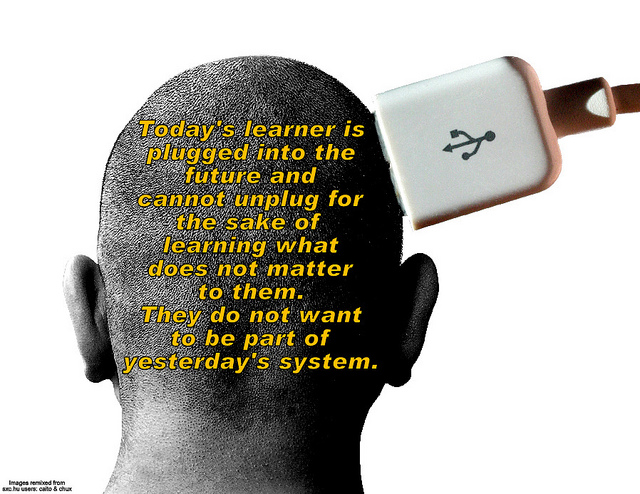
*Image remixed from sxc.hu users Caito and Chux, and includes an original quote.

Originally published at Smart Blogs: http://smartblogs.com/education/2012/06/29/snapshot-modern-learner/