Tuesday, September 24, 2013

Niagara Frontier Reading Mini-Conference


Join the NFRC in kicking off our professional development series
for the 2013-2014 school year with our first “Mini-Conference”
ever! Not only will you receive membership in the Niagara
Frontier Reading Council and the New York State Reading
Association, you also will be treated to insights from Kathleen
Ferguson, 2012 NYS Teacher of the Year. She will inspire us to
strive for excellence in teaching and motivate us to meet the new
school year’s challenges with renewed vigor and enthusiasm!

The NFRC Fall Mini-Conference also will include the launching of
the NFRC Professional Book Club! Your registration fee includes a
FREE copy of the book, which retails for $29.95! You won’t want
to miss this event! Register today!

See the Flyer for the event HERE.

Registration Form HERE.

Visit the NFRC webpage here: http://www.thenfrc.org/

THIS IS THE BOOK THEY ARE GIVING AWAY.

Tuesday, July 30, 2013

An Open Letter to the NC GOP

An Open Letter to the NC GOP:

You have failed the children of your state.

This is not meant to be just a dramatic sentiment that pulls the heartstrings of the reader. It is meant to remind the people who put you into office that you are incapable of doing what is best for children.  

With your new budget, you have effectively dismantled the education system in your state and sent a clear message to all of your teachers. That message is: get out while you can.

Who among you in the legislature wants to feel devalued in their profession? Who among you would like to better themselves professionally at your own expense without seeing the rewards of doing so? Who among you would like the rug pulled out from under you every time you turn around? Who among you would like to lose their job when a poorly constructed performance evaluation indicates that you are terrible at what you do though the parameters of the evaluation are, in large part, beyond your control? Who among you qualifies for public assistance as an educated and employed professional?

A decade ago, there were projections being made about the number of teachers that North Carolina would need in the coming years. At the time, back in 2003, it was tens of thousands. Because of the populations of students in some of your neediest areas, teacher turnover was already excessively high, and that’s before factoring in class sizes, high-stakes testing, and low pay. Exclusive of teacher assistants, NC has approximately 90,000 teachers teaching approximately 1.5 million students. That’s a ratio of about 1 teacher for every 17 students, a generalization that doesn’t factor in geography, population concentrations, content area numbers or grade level numbers. That generalization also doesn’t factor in which of those 90,000 teachers are Special Ed or intervention level support. We do know that class sizes are already too large in many cases and they are about to get larger.

The legislature has paved a road of inequity upon which a mass exodus of teachers in your state will walk.

When you planned for the gutting of education in NC, did you also plan for the consequences; the ramifications of your actions? What will this mean a year from now? 5 years from now? 10 years from now? Is public education blatantly being sidelined in preparation for the privatization of learning, a step that will reward the haves and punish the have nots? Did you plan for who will ultimately clean up the mess you’ve created, which, in the long run will be potentially more expensive than justly funding education in the first place?

I’m ashamed of your willingness to make your constituents feel abandoned and hopeless. I’m sad that the pervasive mood going into the next school year is one of defeat, anguish, and despair. I’m deeply troubled that students will ultimately be the ones affected when the quality teachers move on to greener pastures.

The only hope I have is that those NC Teachers going back into their classrooms this Fall will teach civic responsibility, community values, and critical thinking like they’ve never taught them before, so that this generation doesn’t grow up believing that public education is an undeserving budgetary castaway. I hope that NC Teachers will teach how deeply we must know our elected officials and what they stand for and what they won’t stand for.

I also hope that your children, especially those in public schools, have what they need to be prepared for college or careers in light of the extraordinary obstacles you have placed in front of your state’s teachers.

I stand in solidarity today with my educator brothers and sisters in North Carolina.

Mike Fisher
Former NC Teacher


Tuesday, July 9, 2013

Dealing with the Random Standard

I’m largely okay with the Common Core Standards.

Anyone who reads me regularly already knows this. There are limitations, sure, but by and large, they are better than previous individual state standards that, for the most part, prepare children for 1992, but aren’t so great at preparing them for 2025.

That said, there are places where the standards are either inconsistent, out of order, or blatantly strange. This blog post is about the blatantly strange. This blog post is about Reading for Literature, standard #6, for grades 9 and 10. Here’s what the standard says explicitly:
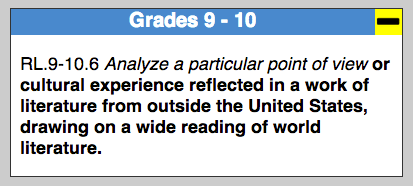

Image: @Janet_Hale from her CCSSELAPP.com web app

Everything up to this point in the 6th Reading for Literature standard, and in the standard after, are all dealing with Points of View (or perspectives) on a sophisticated level from one grade level to another. Then, in 9th grade, we drop the “outside the United States” part in there where it hasn’t been seen before and won’t be seen in the 11th and 12th grade. Random. Random. Random.

However, random or not, we still have to deal with it.

My colleague Janet Hale, who brought this standard’s specificity to my attention, and I had an in-depth conversation about finding appropriate middle-school and high-school works from a “wide range of world literature” given that the works cannot be published in America, even if the story focus is from another country (The Kite Runner, for example).


We were struggling to come up with quality texts that were both worthy of cross-cultural analysis and had analogues or comparative universal themes. We wanted to attend to the capacities around global perspectives without being U.S.-centric while also attending to the valuing-evidence and critical-thinking capacities.

After continued discussion of the implications of this standard while considering curriculum design, we decided that it would be advantageous to tweet out about our thoughts and leverage our digital learning network to find world literature (especially short stories) read by middle-school and high-school students in other countries that American students can read via an English translation. Not an easy task, but we started getting titles from around the world.


Why does this matter?
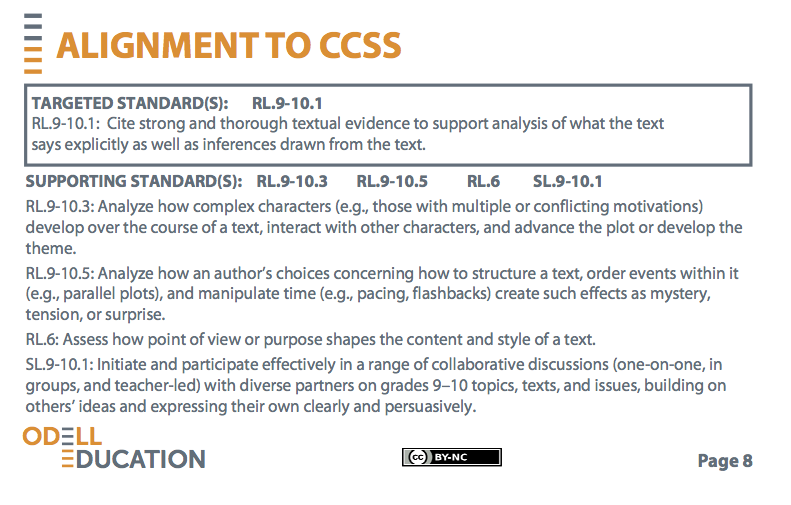

Let’s take a look at the Grade 9 unit from Engage NY, “The Short Happy Life of Francis Macomber.”  Here are the standards addressed in this unit:


Image: Engage NY, screenshot from Grade 9 unit

Notice that the Reading for Literature standard number 6 is an anchor standard (RL.6) rather than a grade-specific standard (RL.9-10.6). Using the grade-specific standard would necessitate a work of literature from outside the United States as well as an American-published text, keeping in mind that analysis is also part of the standard.

To be fair, a key design feature of these Odell Education’s materials is adaptability--the ability to use some of the strategies and supports around a different text. This is important. Because Odell chose to focus on the anchor standard, they are maintaining the spirit of “point of view” and “perspective”, which is one way to deal with what may appear to be a random standard.

Is it okay to always revert back to the anchor standard when a grade level-specific standard is difficult to address? Not really, though it is dependent on several factors, primarily on whether or not the standard addresses content that will be frequently assessed, has leverage in other content areas, or is a lifelong skill that students will need. Another dependent factor is readiness. Previous to the 9th grade standard, there is no mention of texts outside the United States, but it doesn’t mean the support in previous grade levels should be ignored. The College and Career readiness capacities, which I see as the umbrella of the ELA standards document, demand that students who are college and career ready “come to understand other perspectives and cultures.” Even if not specifically in the standards, we can apply this capacity to instruction in both planning and action.

While there are teachers who may have flexibility concerning which grade-level standards get a stronger emphasis, what about those teachers who must adhere to the letter of the grade specific standard versus the spirit of the anchor standards?

This question brings us back to our digital learning network’s collaborative Google doc. We need resources to be able to engage this standard and we need a worldwide cadre of educators to connect and discuss with. We don’t yet know if all of the recommendations are appropriate (e.g., text complexity, rigor) given that they are new texts to us, some of the intended rigor or complexity may be subjective, particularly if they are being used based solely on quantitative measures (Lexiles). Through reading and analysis of qualitative measures and reader/task considerations, conversations around these international texts could yield wonderful opportunities for classroom use or possible unit substitution as a resource. (Janet and I also love the idea of having international students Skyping with American students during and after they read one another’s text based on deep understanding of the text, universal themes, and subsequent analysis found in both texts.)

So, in a nutshell, let’s recap how a teacher might deal with the random standard:

  • Revert back to the anchor standard, the “spirit” of what students need to know and be able to do.
  • Address the standard specifically with new resources and collaborative curriculum design. (Perhaps even have conversations about scaffolding in previous grade levels for the sake of readiness to meet the standard where it lives in a particular grade level.) This attends to the “letter” of what students need to know and be able to do.
  • Be mindful of how the random standard relates to the College and Career Readiness capacities and plan accordingly. This attends to a more overarching vision of college and career readiness that is perfectly appropriate to consider when planning and delivering instruction.

The blatantly strange standards sometimes give us great launching points for collaboration, global conversations, and shared resources, as it has in this case. If you’d like to continue the discussion, please comment below, contact me or contact Janet, or contribute to the Google Doc yourself.


Upgrade Your Curriculum, now available from the ASCD Bookstore.


...

Wednesday, July 3, 2013

Awesome (FREE!) Summer PD Opportunity!

Janet Hale and I have just recently finished working on a Learning Path for EduPlanet21's Flipped Learning Online Professional Development Website. We used the Upgrade Your Curriculum book as a basis to create a "24-7" "always available" workshop that participants can work through on their own time.


In order to start populating the Learning Path, we are looking for 10 volunteers to complete the Learning Path this summer. The entire path, from beginning to end will take about 6-8 hours to finish, though the implementation will involve actually teaching the upgrade and providing feedback. (Summer school teachers are welcome!) There is not an expectation that the Learning Path must be done in a day, or during a small window of time. The beauty of the system is that it can be done on YOUR time.

Eduplanet21 is giving Janet and I 10 free licenses to work through the Learning Path this summer, so that we can tweak whatever needs to be tweaked and refine and revise based on user feedback. If you are interested in participating in this field test opportunity, please respond below in the comments section or send me a message via Twitter to @fisher1000. We are looking for those that will be able to commit to contributing to the full Path, though there will be no charge whatsoever! Totally free opportunity!

If you'd like a sneak peek at the preview trailer for our Learning Path, CLICK HERE!

If you'd like to be part of the initial cohort, we'd love to have you! Janet and I look forward to working with you!

Friday, May 24, 2013

Virtual Summer Camp 2013!


It’s Finally Here!

I’m pleased to announce the Virtual Summer Camp for 2013, the 5th Anniversary of the original!

This year’s Virtual Summer Camp was created with Weebly, a web tool that lets the user create their own website from a variety of templates. In the past, I’ve used different web tools that included Blogger, LiveBinders, Scoop.it, and Learni.st, always looking for different ways to visualize the camp.

Access to all previous camps is included here as well as an array of brand new offerings. The offerings this year are broken into three areas: New Web 2.0 Apps, new Mobile Apps, and a Campfire section that is specific to professional development and global connectivity.

All of the Web 2.0 Apps and Mobile Apps are geared toward Multi-Mediating your professional practice, enhancing singular media content and looking for opportunities to invite multiple versions of content into the learning process.

I purposefully limited the offerings this year for two reasons...24 opportunities are still a lot to investigate AND you have access to previous years Summer Camps that open up multiple opportunities for further resources if you choose to explore them.

I encourage you to not only investigate the offerings in the Virtual Summer Camp but also to investigate Weebly as a Web 2.0 tool. It’s easy to create a website and the drag and drop interface is so easy to use. While it took me awhile to find the individual resources for the camp; it took a minimal amount of time to actually create the Weebly page to house them. This alone could be awesome for students as a demonstration of their learning, allowing them to show and share what they know in a free platform.

I wish you the best of summers! Teachers are amazing, especially in the wake of all the media attention around evaluations and value added measures. I know that you do what you do because you love kids and you value the system of instruction and preparation to move kids to a desired destination. You are rock stars and I am humbled by your efforts, regardless of the bureaucracy and political issues. You do what’s best for kids and I wholeheartedly support that! I hope that you find some useful resources in what I’ve put together for this year’s summer camp.

I look forward to conversing with you and enhancing the offerings as the summer heats up. Keep up the good work and know that you are valued, awesome, and integral to the growth of our country and citizens! You are amazing, and I’m so honored to share this Virtual Summer Camp with you!

Have a great Summer 2013!


Note: The new site is optimized for Mobile Devices too, so you can camp on the go!


Upgrade Your Curriculum now available in the ASCD store


Wednesday, May 22, 2013

Core Talk App


One of the best things about the internet is the amount of information available. However, that's also one of the worst things about the internet. Trying to find relevant and useful information is becoming increasingly difficult especially for educators looking for resources that matter to them.

I find a lot of value in resources and apps that sort and curate information for me. It saves me tons of time versus searching for the same resources myself and leaves me time to contemplate how I may use a particular resource, versus putting all of my thinking energy into endless and mindless searching.

I've recently come across a new resource called "Core Talk." It's an APP that collects and sorts information around the Common Core. The information that it collects is tagged in the background so that you can further sort what's meaningful and relevant to you with a couple of taps.

The app collects news and resources around the Common Core and displays it in a news feed format. You can also see those news items that just relate to Professional Development and State Standards. (Some states added additional standards to enhance the Common Core.) You can drill in by state, personalize what you see, and even save those resources in the app that are most relevant to you and your professional practice.

With the amount of work I'm doing around the Common Core, I've found this app to be extremely useful, particularly because I can quickly find relevant and timely resources, save those resources AND share them all directly from within the app.

I like this app so much that I'm making the Core Talk App the "App o' the Month" in the "iPads in Schools" LiveBinder.

If you'd like to try it out, click the icon above or JUST CLICK HERE!


Friday, May 10, 2013

Release The Tests!


Full disclosure: I am a New York Network Team Representative that is charged with taking the message of NY State Ed back to my participating districts. I attend meetings in Albany several times a year and then share this information with the schools I work with and help them understand and implement all that is coming in the wake of Race to the Top.

I believe in helping teachers help students. I believe that students are the focus of everything I do. I believe that some of this initiative, including the new Standards, is working but I also believe some of it is not. I believe that teachers are professionals that deserve better than they’ve been treated in the last couple of years (particularly in the media) and I believe that if we trust them with children, then we should trust them with how to instruct and assess those children as well. I believe in fairness and I believe in calling attention to inconsistencies, not for the sake of argument or anger, but for the sake of solving solvable problems and getting this right.

I believe that NY State has an opportunity here to build a new bridge.

But first, a little background:

In August of 2011, I began attending the NY State Education Network Team Institutes--the first of many that I’ve attended where State Ed rolls out initiatives, resources, upcoming expectations, etc. At one of these meetings, I had the very good fortune of meeting Mr. Paul Bambrick-Santoyo, author of Driven By Data. Data Informed Inquiry models were to be part of our message that we took back to schools as schools were expected to form their own inquiry teams for the sake of letting the data guide instructional decisions. The assessments were meant to be more frequent and standards-based with a quick turnaround so that teachers could use the data and make necessary tweaks and improvements to the instructional program in the moment, rather than waiting until the end of the year to see if students “got it.”

The most important part of Santoyo’s message is transparency in the assessment. In order to do the deep analysis required, teachers must have the assessment in hand so that the skills that a student needs to answer the questions could be analyzed. Additionally, having the test in hand means that there are further opportunities for professional development around the structure of the test, the deconstruction of the questions for type and strategy, and the levels of cognition (Bloom’s, Webb’s, etc.) on the assessment and how those compare to the levels of cognition in instruction. Understanding by Design 101.

At these Network Team meetings, we spent HOURS understanding this methodology, preparing to turnkey it to our participating districts by exploring the models and creating our own data analysis spreadsheets and understanding protocols for data meetings. Throughout every single bit of this, we had the assessments in our hands. Again, let me say, WE. HAD. THE. ASSESSMENTS. IN. OUR. HANDS.

We taught our districts to do this exact same thing through their data meetings. Test in hand, begin analysis, use the observations to make changes in instruction to benefit students and their success.

This is not intended to give teachers ammunition for teaching TO the test, this is about understanding skills and strategies that enable students to be successful on assessments. This is not just about multiple choice either--it’s meant to analyze multiple types of assessments but to do so quickly so that students reap the benefits of deep understanding and teachers reap the benefits of planned student successes. This is an opportunity to leverage our professional development to do well what we were trained to do: TEACH.

Jump to now.

New York State just finished administering the first tests that are aligned with the Common Core. They were way more rigorous than previous assessments and both teachers and students struggled. Sometime over the summer, scores will be released, but not the test.

The test will be embargoed and teachers will not be able to see it. State Ed Leadership will say that there are samples available online. They will say that there are curriculum modules to help with understanding skills and cognition to prepare for the assessments. They will say that it’s too time-consuming and expensive to share the tests as new ones will have to be developed.

They will also continue to promote Santoyo’s model on one hand, but deny teachers access to the central message of the model on the other hand. This is the inconsistency.

With all of the stress that teachers are under to both perform and be evaluated on that performance in ways they never have before, there needs to be some team-building going on, something that will bring everyone together for the sake of our students.

There is an opportunity here:  Release the tests.

Teachers need an anchor right now, a shelter in the storm of changes. They need something concrete that will help them and their students be more successful and help them to feel that they have more control over the flawed teacher evaluation system currently in place. There are so many across the state just treading water and releasing the test would be a major lifeboat moment.

Many of the teachers I’ve talked with over the last couple years of implementation will tell you that the Common Core Standards are not bad. They will tell you that with time and continued professional development that we can use those standards as a basis for modern learning practice and to prepare our kids to succeed in the world they will graduate into.

These teachers will tell you that data driven inquiry is important and that they agree that it is necessary. They will even tell you that they are fine with teacher evaluation and that, for the most part, there is a desire to improve professional practice and discover opportunities to do things better and implement new ideas.

They will also tell you that the current evaluation plan is inauthentic, inspiring a checklist of “to-dos” that meet the requirements of Race to the Top but do little to impact practice. They will tell you that a single test score has too many uncontrollable variables such as parent support, home environment, and poverty status to be a reliable measure for any part of a teacher’s evaluation. They will tell you that doing the same thing for all may be equal but it is not fair.

They will also tell you that it is difficult to prepare for an assessment when the potential exists for broad preparation for a narrow secret set of assessed standards.

Release the tests.

Teachers need to see that they are trusted and valued. They need to see that they are viewed as capable collaborators in this quest for college and career readiness. They need to see themselves as part of the whole team.

Release the tests.


Follow Mike on Twitter: @fisher1000

Upgrade Your Curriculum now available from ASCD.org

Thursday, April 18, 2013

The Flow of Professional Development: An INFOGRAPHIC

I just created an infographic based on a conversation that I had with teachers and administrators at EdCamp Buffalo last weekend. During the conversation, I was explaining that Professional Development sometimes falls flat because the groundwork hasn't been properly laid. In essence, professionals don't always understand or contribute to their needs around meaningful Professional Development. I created a flowchart in the moment, but thought I would use an infographic maker, Piktochart, to better visualize the conversation.

It launches in its own iFrame and may take a moment or two to load:


Wednesday, April 17, 2013

Contextual and Authentic


I’m working with a new group of collaborators who happen to be in the fourth and fifth grade.

Nine to eleven year olds from the Martin J. Gottlieb Day School (http://www.mjgds.org) are creating a book based on some kids’ poems I wrote decades ago and are illustrating them and publishing them and selling them and creating a marketing plan around our work. Eventually, they will use what they’ve created as a fundraiser for their school.

These students are participating in a new form of learning that involves a mentoring relationship, new classroom roles, and embedded virtual learning. I’ve been able to Skype with them, email feedback about their work, and create additional learning “side trips” based on in the moment opportunities.

Their art teacher, Shana Gutterman- http://shoshysartroom.blogspot.com/, their classroom teacher, Stephanie Teitelbaum- http://teachblogandtweet.wordpress.com/,  their Learning Coach, Silvia Rosenthal Tolisano- http://langwitches.org/blog, and I virtually collaborated on the development of this project, via Skype, email, and Twitter. We came up with objectives and lesson activities and planned virtual sessions. We had a modern learning plan in place and launched our project with the intent of changing the level of engagement and learning with students.

Then, we discovered something. Something big.

Because of the depth of instruction and the built in time to negotiate new roles for the students and the upgrade of seeing themselves as collaborators rather than passive learners, we struck oil! Silver! Gold! Students began to self identify interests that were related to their planned learning and lead us down paths of unplanned learning that enriched the designed project.

While students were working on designing pictures to accompany poems in a book for multiple audiences, they also opened up cans of worms that were unforeseen in the curriculum design. These were some of the “teachable moments” the “side trips” that came out of our collaborative work:

  • Students learned new contextually specific vocabulary words such as emphatic, explicitly, iteration, synesthesia, and negative space.
  • Students were invited to investigate the meaning of “chiaroscuro” as it related to contrasting elements in their illustrations.
  • Beyond the chiaroscuro investigation, they were invited to read a book, The Tale of Despereaux, which explores chiaroscuro as a metaphor for the characters and action.
  • Students were asked to investigate and learn about Grandma Moses and art techniques that involved the layering of backgrounds and foreground elements in a painting.
  • Students learned about warm and cool feedback and improvement for the sake of the team versus just getting good grades.
  • They learned to articulate the reasoning behind the “why” of what they were doing and to be as specific as possible in deciding why their illustrations were a good fit for the poem’s text. They did this both with me and their peers, which I personally think is hugely significant. Once again: their peers helped to inform their improvements.
  • They became open to suggestions that were rooted in improvement versus identifying what was wrong with their work. This positive take on “doing what’s best for the intended audience” was a huge shift in meaning making.
  • They learned that its okay to explore different interest areas that were outside of the intended learning, particularly with one student that wanted to create his own comic books. We were able to have a conversation about the usage of Comic Life on the iPad to start designing his own graphic novels.
  • They learned to respond to different types of feedback from their formal teacher, their virtual collaborator, and their peers as they shaped their work.


I would also like to add that the students referred to me as their collaborator; that the work we were doing was OUR work. I loved that. I also loved that their classroom roles included roles like “Skype coordinator,” “Twitter Expert,” and “Illustrative Notes Expert.” So far beyond “Reader,” “Writer,” and “Notetaker.”

Authentic learning experiences that ask students to be part of the instructional design process AND the product are critical in the modern learning classroom. Student-centered work becomes student-owned learning even if teachers maintain an instructional anchor. In this case, the anchor was the product: the book. Everyone is contributing to it, though in multiple ways and with multiple extensions around their individual learning.

I should also mention that this project, because of the level of collaboration between teachers and students, was not a neatly contained event. It took some time to develop, to interact, to collaborate both virtually and in person, and even after these several weeks, the students are just now gearing up to start working on the marketing plan. As teachers, we had to find a new common ground of comfort when balancing the time it takes to do something like this with the deep learning that was possible.

Also, if you’d like to look at the project from several points of view--there’s a lot of blogging going on around it:

Learning in the Modern Classroom - by Silvia Rosenthal Tolisano
Assessment in the Modern Classroom - Part 1, Part 2, Part 3 - also by Silvia

Student Blogs:
And my favorite on vocabulary: Wacky Wacky Words!

Needless to say--but I’m REALLY proud of my collaborators! I will be presenting with them at EdJEWcon in Jacksonville, Florida in a couple of weeks. I couldn’t be more excited to finally meet them in person and see our finished product! I’d also like to say Thank You to Shana, Stephanie, and Silvia for all of the great professional collaboration.


Upgrade Your Curriculum - Now available from ASCD

Picture from Pixabay