Thursday, July 28, 2016
Review of Hacking the Common Core!
The nice folks at MiddleWeb reviewed Hacking the Common Core! Thanks, Rita Platt--I appreciate what you wrote!
View the review HERE
The book is on Amazon HERE
Tuesday, June 21, 2016
Have a Summer of Fun with Reading and Writing!
originally posted on MiddleWeb
Read the rest of the blog here!
Now that we are all fully heading into the summer, I thought it would be a good time to talk about summer reading and writing and how to get kids to continue with their literacy efforts over their break.
Over the weekend, we had a great #HackLearning chat on Twitter (Sunday’s at 8:30 AM) on promoting summer reading, and a lot of great ideas were shared. In the interest of expanding that conversation, I’d like to share a few ideas to help parents and teachers #HackSummerLearning!
The best thing that teachers can encourage their students (and parents) to do over the summer is to simply read and write. Kids can read anything of interest, preferably at an instructional level (which might necessitate teachers sharing reading level information with parents). Teachers can then encourage parents to have a daily or every-other-day reading habit.
A pleasure, not a chore
Sometimes parents get lost when the expectation is to keep up with reading logs and document every page their kid reads. Remove that accountability and use the honor system to help encourage parents to keep up with reading.
Or even better, leverage social media to replace the reading log and have students and parents tweet to a teacher or school-specific hashtag sharing their favorite moments, titles of books, plot twists, favorite characters – anything!
Don’t make the reading just a student event. Even if the students are older, ask that parents read to their children and have discussions about what’s happening in the books the kids are reading for themselves.
Additionally, summer is a GREAT time to start co-reading events where the parent(s) and the child read the same book and have discussions about happenings and inferences.
Another option is “post mortems” where everybody talks about the book in general. We are doing that this summer with our nine year old. We’ve been waiting years to share Harry Potter with her, and this summer is the summer of Harry for us. My wife and I are so looking forward to sharing this with our daughter and can’t wait to rediscover “the magic!”
Read the rest of the blog here!
Tuesday, April 12, 2016
Tuesday, March 1, 2016
Hacking the Common Core
I'm so pleased to announce that Hacking the Common Core is Now Available on Amazon.com in both print and eBook formats!
From the publisher:
Are you ready to bring the fun back to learning?
From the publisher:
There Is Nothing Common About This Common Core Book
It's finally here: a book that unravels the Common Core State Standards, exposes the myths, and shows educators and parents exactly how to bring back the fun to teaching and learning--even in a standardized world.
In Hacking the Common Core, longtime teacher and CCSS specialist Michael Fisher reveals 10 amazing hacks for teaching the Core in all subjects.
The Common Core Is Not Evil, but. . .
Fisher explains how the CCSS are not evil, while demonstrating their limitations, particularly when teachers trust a vendor product over their own professionalism. Getting to the CORE of contemporary instructional practice and undoing the mass hysteria following the Common Core implementationare both the heart of this book.
What All Education Stakeholders Will Learn
- How to bring literature back to the classroom
- The truth about close reading
- What the instructional shifts really mean for instructional design
- Why we must ditch “Rigor” in favor of “Vigor”
- How to fix vocabulary with "Morecabulary"
- How to upgrade the verb
- The problem with the one-size-fits-all mentality
- Why parents need to understand the Common Core
Change How You Teach
Hacking the Common Core is the book that every teacher who feels handcuffed by standards and testing has been waiting for. It's time to take back your class, engage all learners, and be amazing for your students.
The Hack Learning Formula
The Hack Learning Series formula is perfect for Hacking the Common Core. Forget everything you've heard about standardization and the Core. Fisher throws out or upgrades most information and strategies, and in classic Hack Learning style, he gives you:
The Problem (Common Core issues that need a Hacker's mentality)
The Hack (ridiculously easy solutions that you've likely never considered)
What You Can Do Tomorrow (no waiting necessary; you can make writing immediately)
Blueprint for Full Implementation (a step-by-step action plan for capacity building)
The Hack in Action (yes, people have actually done this)
The Hack (ridiculously easy solutions that you've likely never considered)
What You Can Do Tomorrow (no waiting necessary; you can make writing immediately)
Blueprint for Full Implementation (a step-by-step action plan for capacity building)
The Hack in Action (yes, people have actually done this)
Are you ready to bring the fun back to learning?
Wednesday, February 10, 2016
Triptiks Can Rev Up Student-Centered Learning
Originally published on MiddleWeb
Read the rest of the blog HERE!
NOTE: “Triptik®” is a registered trademark of AAA and is used with permission.
In my workshops and my most recent ASCD book, Ditch the Daily Lesson Plan, I advocate for teachers to work smarter, not harder, and to learn how to plan curriculum for contemporary classrooms and contemporary students.
My overriding message is still focused on high levels of student engagement. We also want to be sure we include discovery level learning opportunities that are authentic and timely.
One idea I like to propose for discovery learning is what I call “The Triptik.” I use it as a metaphor for co-creating a learning experience with students where the students are largely responsible for getting to a destination once the destination (or learning objective or project deliverable) has been established.
Those reading this who remember the American Automobile Association’s Triptik® will probably recall that a member would set a destination and then AAA would design a packet of information to help get you there in myriad ways, allowing you to know about construction, alternative routes, direct and indirect paths, places of interest to enhance the journey, etc. The traveler would then have everything they needed to shape a unique travel experience.
I think this method can well apply to contemporary curriculum design, particularly when we shift much of the responsibility for the (learning) journey to the student. While student choice and voice are important in all contemporary classrooms, they are vital in the Middle Grades classroom, where students have a built-in longing to explore, discover, and create.
Tips for creating classroom Triptiks
In order to design a Triptik® in your classroom, ask yourself the following questions:
- What is a learning journey worth embarking on? This can be a negotiation between teachers and students. Teachers have an understanding of the objectives, standards, etc., but student voice here could reveal iterations of the objective that create opportunities for buy-in and high levels of engagement.
- How do I align the journey to standards, and how will I assess it? Whatever the learning experience will ultimately be, the teacher still needs to coach students through learning expectations and coach towards success on whatever the assessment will be. (Hopefully it’s one that is co-designed by students and teachers!)
- What are the essential skills that students will need to master as they embark on this learning journey? These essential skills will be determined by the assessments that are designed as well as any standards that a teacher aligns this learning experience to. Additionally, other skills related to the designed task may need to be documented, particularly if they are part of a negotiation with the students on how they will work, learn, and perform. (Such as Habits of Mindor even peripheral skills related to contemporary research strategies.)
- What questions need to be asked? Focus the work for the team by helping students develop questions, both essential and supporting, that facilitate students’ finding the right resources to advance their learning and lead them to their learning destination.
- How will students and teachers (and anyone else involved in the learning process) communicate and collaborate? Co-creating tentative instructional tasks based on skills and group-brainstormed ways of getting to the assessment / product (where students’ voices impact the planning and delivery of instruction) will allow students a window into what teachers must consider when designing instruction. This conversation could help students self-advocate for scaffolds or opportunities for differentiation.
- How will students be accountable for their work? Be mindful of the destination while you work to get there, setting instructional milestones and providing ongoing feedback. In the Middle Grades classroom, feedback is essential to quality work and improvement. Think of creative ways to distance yourself from traditional grading in favor of helping all students generate a quality product.
Read the rest of the blog HERE!
NOTE: “Triptik®” is a registered trademark of AAA and is used with permission.
Saturday, January 16, 2016
Category Cubes: An ARIAS Addendum
I’m so excited that the Ditch The Daily Lesson Plan Arias book is doing so well. I’m glad that it’s resonating and that teachers are finding value in new ways of thinking about instructional planning.
I thought I would add a little amenity to the book for the New Year. What I came up with is called “Category Cubes.” I took the content for the cubes from the section of the book where I describe an inquiry process that I call “The Triptik®.”
The basic idea of “The Triptik®” is that a learning destination is co-created with teachers and students but students are largely responsible for getting to the destination once the destination (or learning objective or product) has been established / agreed upon. Think about what the AAA company does for it’s customer. The customer decides on a destination and then AAA designs a packet of information to help the customer get there. It includes construction along the way, alternative routes, direct and indirect ways to get to the destination, places of interest, and suggestions for stopping points. The customer would have a one-stop shop of everything they would need to take a unique journey.
I thought this was a great metaphor for instructional planning.
In explaining “The Triptik®,” I describe a way to help teachers co-create instructional parameters around potential research or project-based goals. These include a student’s ROLE, their ORBIT, their TASK, how FEEDBACK is collected and used, and LIMITING FACTORS.
I expanded these parameters into potential student actions and created cubes or dice for students and teachers to use to help with instructional design.
A couple of notes about using them:
- Consider printing them on cardstock for improved durability.
- There is a blank template you can use to create your own cubes or perhaps have your students make their own cubes.
- What ever kind of project or inquiry your students are engaging in; it is not necessary to use all of the cubes. You may only need one, you may use more than one to help scaffold or sophisticate.
- On the Feedback cube, there are several ways listed for students to get feedback. You may have to provide some direction / coaching for team, self, or social media feedback.
- On the Orbits cube, note that students may need some coaching help when navigating social media, asking an expert, or creating a good survey.
- On the Role cube, I included a few examples of potential roles for group inquiry. There are many more roles that students could take on. Feel free to remix or revise at your discretion.
- These cubes may be helpful when students are making initial decisions and they may be good for refining their decisions once their work is underway. I hope you find them useful.
I’d love to know of your successes if you’re willing to share them in the comments section below. I sincerely hope each of you has a fantastic 2016!
Happy New Year!
Mike Fisher (on Twitter: @fisher1000 )
Available now from the ASCD Arias series:
Also available from ASCD:
Triptik® is a registered trademark of the AAA company and is used with permission.
Friday, January 15, 2016
Sunday, November 15, 2015
Rebooting the Curriculum
Turn the machine off, count to five, and power it back up again. The system has been “on” too long and we’ve reached our limit of redundancy looping warnings. It’s time to upgrade the operating system, to invite innovation, and to become contemporary teachers of contemporary learners.
One week from today, I’m pleased to announce that my new ASCD Aria, Ditch the Daily Lesson Plan will be available. It’s a book designed to be read one day and acted on the next. It’s a book that is full of strategies to plan curriculum design in ways that invite learner involvement, minimize daily documentation, and get to the heart of authentic ways to teach and assess students and their learning.
This is a book unlike any I’ve written before. It comes from observational and anecdotal data gathered in the last few years of working with schools around modern instructional methods, where “what-ifs” became “what-nexts.” In the book, I share three different alternatives to traditional curriculum design that include the creation of Mini-Units, an all-inclusive Curriculum Cache, and a journey inspired Triptik™ model that relates the awesomeness of the AAA Travel Planner to contemporary curriculum design.
The book also includes a list of other stalwarts of instruction to ditch including the lecture, internet filters, worksheets, and more.
I’m so excited to share this new work with you and I’ll be sharing extensions of the work here in the coming weeks, so that the original text will serve as a launching pad and I’ve got plenty of material to fuel the fire.
Contemporary students need contemporary teachers. I hope you find what I’ve written to be a step that direction. This book is 100% a partner with my previous Aria, Digital Learning Strategies, and between the two I hope that I’m hitting the sweet spot of the overlap between 21st Century Ideas and Contemporary Curriculum Design. Both are important for today’s learner.
Stay tuned. Next week I’ll share some of the additional ideas that I had for the new book as “Curriculum B-sides.” While these ideas didn’t ultimately make it into the text, they are still potential discussion points for making curriculum design more contemporary and inviting for multiple stakeholders in your curriculum conversations!
Follow Mike on Twitter: @fisher1000
Mike’s Website: digigogy.com
Ditch the Daily Lesson Plan, available for Pre-Order from ASCD
Digital Learning Strategies, available now from ASCD
Upgrade Your Curriculum, available now from ASCD
™Trademark for Triptik belongs to the American Automobile Association, used with permission.
Sunday, July 19, 2015
Covering the Curriculum
In a meeting with middle school ELA teachers in Northern New York State,
the topic of coverage came up with a visceral passion. Because of new
standards, new curriculum requirements, new assessments, and new evaluations, teachers
were feeling the pressure to make sure that they covered everything that might
be on THE TEST. These teachers
participated in several benchmark tests throughout the school year as well as
offered multiple opportunities for the students to demonstrate learning through
more formative assessments that happened often.
They told me that in the last two years of state testing, their students had performed, collectively, at historic lows and that the average level of proficiency was hovering around 25% for both years, despite the fact that they felt as though they covered everything. They described, with pride, how they focused on on-task behaviors and making sure that they systematically got through all of the standards associated with the new curriculum materials and the testing guides put out by New York State.
To summarize, the teachers covered 100%, or as close to 100% of their curriculum through their detailed daily lessons and unit plans that systematically covered the standards. Their students, after participating in these lessons, scored at a level of 25% proficient.
Now, some caveats. Scoring 25% on the one state test is virtually meaningless. It is a standardized test that is designed to quickly measure what a student knows and is able to do at a specific point in time under specific testing conditions. It is a pulse, not a diagnosis. In this case, it is a potential checkpoint of the impact of teaching on student learning and is not the only factor in the discussion with these teachers. Proficiency on tests like this, and perhaps on just about any assessment, is relative to other variables: readability, fatigue, interest, time, hunger, etc.
We can’t necessarily quantify learning with standardized tests in the same way we can’t weigh a student’s brain before and after learning to see if the new knowledge causes a brain weight gain. It’s imperfect science. It’s just a pulse. Is it nice to know the pulse? Yes. Is it the only diagnostic measure a teacher would use as an artifact of learning? Certainly not.
Besides the state tests, these teachers also told me that the benchmark assessments and many of the formative assessments also showed low levels of proficiency though there were moments of bright spots when the students were really excited or interested in the topic or the engaging ways in which a teacher chose to teach.
Based on what these teachers told me, these were the conclusions that I shared with them:
- They need to talk about the standards. Which ones fit together naturally, which ones have priority over others based on several lenses: readiness, endurance, leverage, and yes, the end of course assessment.
- They need to talk about the tests. The tests seem to matter more for teacher evaluation, and, as one Board of Regents’ Member said on CNN, for taxpayer accountability, then they do for actual student performance. If that’s the case, understanding the parameters of the testing lens and having discussions about priorities help them to teach for success no matter the assessment rather than teaching to the test.
- If they teach 100% but the students demonstrate at a 25% level, what would happen if they teach 75% (based on the priorities)? With time and depth, what positive changes would they expect to see in proficiency?
- Giving benchmark assessments and formative assessments, but not using the data to inform future instruction despite the rigidity in their lessons and pacing, is like noticing a kid’s shoelaces are untied and rather than stop and tie them for improved performance, forcing them to run even faster down the track, ignoring the tripping and slipping.
- The detailed lesson plans and coverage mindset is robbing their students of time to think and process, of being creative, of having choices in process and product, and of real learning.
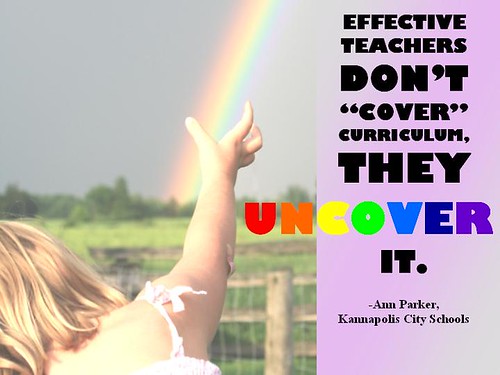
- Learning doesn’t happen because something is taught. Learning happens when something is discovered.
If we are simply covering the curriculum, or letting textbooks or vendor
products divine our practice, how do we really know that students have learned
what we intended for them to learn? Deep learning can’t happen with
micromanaged details, nor can it happen with our insistence upon covering everything.
Perhaps a good essential question to ask might be, “How can we UNCOVER the curriculum?” Or maybe, “How can we be less formulaic and more exploratory in the learning process?” Now that summer is here and many of us have some time to devote to curricular examinations and upgrades, perhaps these two questions would be good to start a discussion with?
Upgrade Your Curriculum now available from ASCD.
Digital
Learning Strategies now available from ASCD.
Ditch the Daily Lesson Plan coming soon...
Join
me and the rest of the Curriculum 21 Faculty for Connect 21 Camp at
Washington's National Harbor Gaylord Hotel from August 6-8, 2015! CLICK
HERE FOR DETAILS!
Monday, February 9, 2015
#BookItForward with Mrs. P!
Original posting at Learning Personalized:
We are so excited to share our guest blogger this week: Mrs. P from Mrs. P’s Magic Library!

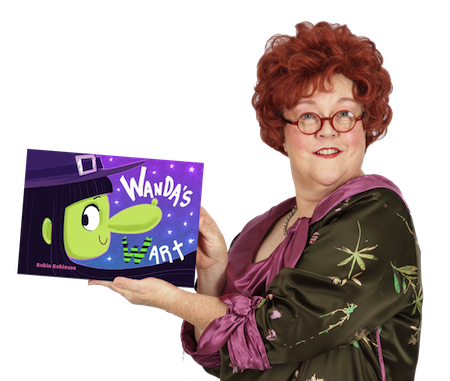
Her favorite book is Wanda’s Wart - written and illustrated by Robin Robinson http://www.robinillustration.com/books/ Wanda's Wart is an all-ages indie picture book about the importance of friendship, honesty—and not being afraid to stand out for what makes you an individual. This story may be a tool for dealing with certain kinds of bullying, and for kids who run the risk of suppressing their interests and talents just to fit in. I love the message that we could all be a little more fearless about being ourselves, warts and all. You can enjoy a reading of this story at my free website too.
Thank you so much, Mrs. P, for sharing your favorite book and helping us to #BookItForward! If you’d like to see and hear much more from Mrs. P, be sure to visit her Magic Library where you can hear stories, play games, and do lots of fun activities!
Now it’s your turn!
What is your recommendation? #BookItForward encourages people to share a book they love with a person they love. It can be a new book, a used book, or a recommendation for a library book!
Here’s how:
We are so excited to share our guest blogger this week: Mrs. P from Mrs. P’s Magic Library!
Her favorite book is Wanda’s Wart - written and illustrated by Robin Robinson http://www.robinillustration.com/books/ Wanda's Wart is an all-ages indie picture book about the importance of friendship, honesty—and not being afraid to stand out for what makes you an individual. This story may be a tool for dealing with certain kinds of bullying, and for kids who run the risk of suppressing their interests and talents just to fit in. I love the message that we could all be a little more fearless about being ourselves, warts and all. You can enjoy a reading of this story at my free website too.
Thank you so much, Mrs. P, for sharing your favorite book and helping us to #BookItForward! If you’d like to see and hear much more from Mrs. P, be sure to visit her Magic Library where you can hear stories, play games, and do lots of fun activities!
Now it’s your turn!
What is your recommendation? #BookItForward encourages people to share a book they love with a person they love. It can be a new book, a used book, or a recommendation for a library book!
Here’s how:
- CHOOSE a great book.
- GIVE it or recommend it to someone who would enjoy it.
- POST a photo of the book tagged with #BookItForward on Instagram, Twitter, or Facebook.
- TAG three people in the post to nominate them to #BookItForward next!
Saturday, November 15, 2014
Dorothy I. Height
Transcript of the video (with additional portions):
While in Washington, D.C. this week, I had the incredible opportunity to visit and work in the Dorothy Height building, home to the headquarters of the National Council of Negro Women.
I was very much moved by the history of the building and the powerful people who have roamed its halls. I thought about all of the historical conversations and decisions that were made in this place and what an absolute privilege it was to be invited into this energy.
There was a magic in seeing tributes to those that shaped civil rights in our country, including distinguished educators and civil rights leaders Mary McLeod Bethune, Dr. Martin Luther King, Jr., and of course, Dorothy Irene Height, whose office I’m showing you right now.
Dorothy Height, according to her biography on biography.com, was a civil rights and women's rights activist focused primarily on improving the circumstances of and opportunities for African-American women. She was a leader in addressing the rights of both women and African Americans as the president of the National Council of Negro Women. In the 1990s, she drew young people into her cause in the war against drugs, illiteracy and unemployment. The numerous honors bestowed upon her include the Presidential Medal of Freedom (1994) and the Congressional Gold Medal (2004), where President Barack Obama referred to her as the “godmother” of the Civil Rights Movement.
While in this office, I was able to see many of the awards bestowed upon her and see the many pictures of Dorothy with the likes of Tina Turner, Maya Angelou, Coretta Scott King, Oprah Winfrey, and many others.
I looked out the window at her view and imagined the thinking that happened in this space and how she was inspired to be both a leader and an activist for equality and justice for all.
My only regret as I view these life artifacts is that I never got to meet her. I was overwhelmed with the presence of the past and thinking about what we, as a country, have learned from the sacrifices of the previous generation. In the 21st Century, how modern are we really and how much do we still need to improve?
I imagine the conversation I would potentially have had with Dorothy Height in this office at this moment, and I imagine her being a woman of just a few, but important words: peace and justice. We are all in a better place because of women like Dorothy Irene Height and I feel so blessed to have been offered this glimpse into the life of such an extraordinary woman.
Monday, October 27, 2014
Advancing Curriculum Mapping: Zombie Edition
I’ve been traveling a lot recently in the car and have had plenty of time to listen to multiple types of media. The last few trips have found me listening to new music, audiobooks, and podcasts from favorite speakers, news and media outlets, and comedians. One of the more interesting podcasts I’ve been listening to on the road is entitled The Walking Deadcast. This podcast is related to The Walking Dead television show from the AMC channel. It’s a show about zombies. It’s also a show about humanity and forgiveness and survival.
It also gave me an idea for upgrading curriculum maps.
The Walking Dead originally was a popular comic book series that was turned into an also popular television show four years ago. There are times when the tv show writers have elaborated on a theme from the comics and times when they stick fairly closely to the written storyline, as they currently are in this season of the show. I’ve been interested in the show since it began, but am only now discovering the podcast.
What struck me about the podcast the most is all the integrated elements. The hosts, Jason Cabassi and Karen Koppett have a natural rhythm to their conversation and set up their shows in a similar format. The format, in general, looks like this:
- The show begins with their Aha! moments and then the sharing of their top 5 favorite moments from the previous show. They discuss thematic elements, analysis of observations, speculations on what may be coming next, and comparisons to previous shows or thematic elements. All of this is rooted in evidence rather than just opinion.
- Jason and Karen then look to the masses and share what people are saying through multiple social media platforms including Facebook, Twitter, Pinterest, Tumblr, and their own website. Some of this is fluff, but some of it has a direct bearing on either supporting what they discussed already or causing them to think in even more divergent ways. Again, they continually refer to evidence from the show to support or shift their thinking or the thinking of the interactors.
- The hosts then invite Comic Book experts Erik Feten and Gracie Lou to share how closely the filmed show aligns with the comic book. There is discussion about camera angles and analogous cells in the comic and how the film treatment of the comic, in general, was done.
- Before the end of the show, they share information from multiple news sources that specifically relate to the show, theories about what’s next, reactions to suspenseful events, and more. All of this information is curated by another collaborator, Jason Walker.
- Additionally, they’ve had actors and other folks from the show as guests to share their perspectives.
When I’m listening to this, I’m listening for entertainment, yes, but also for transferable skills that represent knowledge building, engagement, learning, and performance. In this collaboratively developed and performed product of value, this is what I’m hearing:
- They engage in metacognition that values evidence. The hosts of the show as well as the others that contribute are thoughtful about what they say. They continually go back to the show or the comic book to support their reasoning or the reasoning of others.
- They engage in deep analysis. The question the story arc and how the characters, settings, music, etc. all lead to the development of the plot. They notice and discuss (with evidence) themes and through lines that relate to both the current episode and the series as a whole. They delve into symbolism, patterns, perspectives, and more as they deconstruct the episode for deeper meaning and deeper discovery.
- They have created a research product. This podcast doesn’t look like a traditional research paper but it has all of the elements. Claims, counter-claims, evidence from multiple sources and people, all in a formatted and well-produced product.
- Good writing is apparent. In order to pull off this level of professionalism, there has to be some scripting. While some of the dialogue is off the cuff, there are specific elements that had to have been written down: their initial notes, their Top 5 lists with a rationale, what others contributed (even if the original podcasters didn’t write these specifically, they did choose to include some of those contributions. I think of it like quotes in a research paper.)
- This was a collaborative act. The hosts worked together to provide the bulk of the podcast, but invited multiple people and additional media into the process and product.
- This represents an authentic product. I think what the podcast hosts did here represents an authentic product that students in classrooms today would be willing to both create and produce but also be engaged enough to learn at high levels the skills that would be necessary to succeed in the world they will graduate into.
What if this is a new product that takes the place of something traditionally ensconced in today’s classrooms? What if this becomes a valid assessment of learning? What if this was the expectation of the creation of performance tasks that allow for true integration and student responsibility?
What if wasn’t just about zombies?
While this blog is specifically aimed at a Halloween audience, there are many podcasts out in the Internet ether to satisfy anyone’s interests. Students could potentially research and podcast just about anything, engaging in many of the transferable skills that we expect them to be proficient in. This podcast was audio only and so I see immediate upgrades to video as well as the production of a series podcasts that demonstrate learning versus more traditional and potentially less engaging demonstrations.
I’m not saying ditch the research papers, I’m saying think about the skills you expect your students to have and be innovative about the actual product that they create. Let them contribute to the design of the product and increase their level of vested interest in what they are producing.
If that product happens to include zombies, then I think that’s awesome.
Keeping curriculum maps living, breathing documents is work. (Much like keeping the humans alive and breathing on The Walking Dead.) Advancing this work is a constant act of rethinking assessments, methodology, and other instructional actions based on multiple lenses that include new standards, newly available resources, new technologies, and certainly, new students from year to year. Innovation and engagement matter a whole lot with today’s students. Being willing to upgrade, or perhaps abandon, traditional strongholds in methodology and/or assessments is a step in the right direction toward modern curriculum design.
By the way, here is the link to the page with the Walking Deadcast podcasts:
You can either subscribe and get the casts on your device or you can listen to a downloadable mp3 right on your computer.
Happy Halloween, all!
Available Now:
Photo credit: purchased from Fotolia.com - #69992350 - zombies dawn © stuart
Subscribe to:
Posts (Atom)