Wednesday, January 30, 2013

Upgrade Your Curriculum: Repurposing

While doing some work for an upcoming workshop on “Close Reading,” I was thinking about the balance between learning and engagement. Many of the “upgrades” I’ve seen lately do a fantastic job of upgrading the learning aspect but not so much the engagement part.

Students who are working in school only for the sake of learning may not be learning all that a teacher intends. They may simply be checking off what needs to be done in order to move on. Students who are engaged are learning at a sticky level, where ownership and attention are driving them toward maximum performance.

I decided to go digging into my own classroom archives (because it’s OKAY to upgrade from a known starting point!) and found a lesson I used to do with my science students around Bjork’s song, “Joga.” Bjork is an Icelandic singer and I chose the song because of the video I saw on MTV, back in the days when MTV showed music videos! The video is a combination of realistic and digitally manipulated/animated views of Iceland. Iceland sits on a divergent plate boundary and is subject to all kinds of tectonic activities.

My original lesson/learning moment involved a discussion of plate tectonics, Iceland, a viewing of the video, and then what I thought were Higher Level questions. Those questions, it turned out, were more holistic in nature and somewhat touchy-feely. They may have engaged at a creativity level but not necessarily at a learning level.

In our upcoming book, Upgrade Your Curriculum: Practical Ways to Transform Units and Engage Students (ASCD, March 2013), Janet Hale and I advocate for both learning AND engagement. I’ve written about this before and it is now a constant in my thought processes when I start tackling upgrades of any sort. For this particular upgrade, I’m looking for learning and engagement through the lenses of Curriculum Examinations and Higher-Order Thinking. Specifically, I’m looking to repurpose something I already had in my bag of tricks and kick it up ten notches in terms of what the Common Core is asking students to know and be able to do. I’m also kicking up the Higher-Order thinking skills and making the questions less about summary and blanket statements and more about text-dependence and metacognition.

In the Lesson Upgrade embedded below, you can see my original lesson ideas at the end of the document.  There are links embedded in the Lesson Upgrade so that you have all the resources you need to do this in your classroom. I purchased the DVD of the Bjork video so that there would be no Youtube advertising and I could show it in High Definition. The Youtube link is included here, though.


I welcome your feedback. I know there are some issues already with the Text Complexity. I’m walking a fine line of justification here, because of the low lexile measure. I don’t know if it’s a function of the limited amount of text in the lyrics or the lack of high-octane words, but the addition of the visual, the implicit meanings, and the associated domain-specific vocabulary in a science discussion related to plate tectonics made me feel comfortable using this with 6th through 8th grade students.


Cure for the Common Core - eBook available now from Amazon
Mike on Twitter:@fisher1000
Janet on Twitter: @janet_hale
Janet’s New Common Core ELA Progressive Continuums Web App

Upgrade Your Curriculum: Practical Ways to Transform Units and Engage Students - coming in Feb. 2013 from ASCD

Wednesday, January 23, 2013

Upgrade Your Curriculum: CCSS / Technology Lens

In the next few weeks, Janet Hale and I will have our new book out through ASCD, Upgrade Your Curriculum: Practical Ways to Transform Units and Engage Students. We will very soon be launching a new ASCD Edge Group and Discussion Board around the book to discuss improvements in instructional practice and design as well as collect the awesome ideas of all the educators that would like to engage in a dynamic multi-media conversation!

In the book, we discuss different lenses and considerations through which you can view your current curriculum for a particular upgrade. This blog post is honing in on two, technology integration and Common Core alignment. The Common Core alignment is in relation to two reading anchor standards, number one that asks students to read closely, and number ten, that asks that students read and comprehend complex literary and informational texts. For the technology lens, I’ve been playing with a few new web tools and wanted to share some ideas for task-focused instruction.

Additionally, when I refer to “upgrades,” I’m speaking of a two-pronged approach, looking both for learning AND engagement. Effective instruction comes from a balance of these two considerations and while I know they can be somewhat subjective, I am, in general, looking for more student-centered opportunities than teacher-led “to-do” lists.

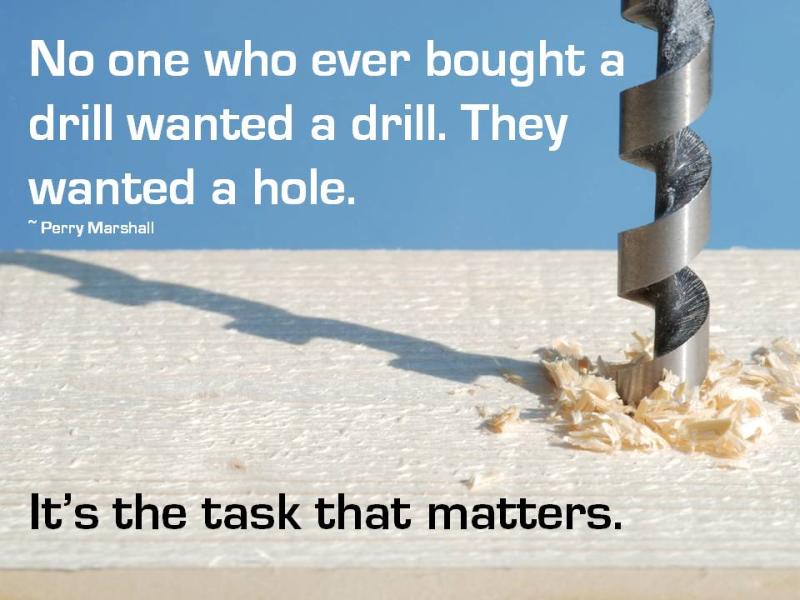
Just a reminder, it’s the task that matters, not the tool. However, I think it’s important to build a repertoire of tools so that you and your students can choose the right one for the task.


So, in light of adding tools to your toolboxes and doing so with specific Common Core ideas, I’d like to share three new tools that I’ve come across recently as well as some ideas for engaging these tools for curriculum upgrades.


Smore.com

Smore allows a user to create flyers with embedded color schemes, fonts, and templates. I used it initially to create handouts for a workshop I was doing and quickly figured out that I needed to prioritize my information so that the message I was sending would fit on one printed page. I created a Smore flyer for this blog post around Text Complexity, specifically considering Reader and Task, from the Common Core document. Here’s the example:


I liked this tool for several reasons and see several opportunities for specific tasks/upgrades using this tool. For one, if students are visualizing their learning using something like this, it promotes eye-catching design. Brain based instructional strategies work because they are different, creating “mental glue” to help the brain retain information. Visuals stick better than text and using a tool like Smore will help students own their learning. Also, if students are writing about text, specifically after “close reading,” this might be a good tool to use for emphasizing important comprehension points or prioritizing the information they may potentially share. In fact, how awesome would it be for students, perhaps in pairs, to prioritize different pieces of the puzzle, with some focusing on text structure, some on vocabulary, some on connections to other texts, some on text based conclusions, etc. This could help establish new audiences, purposes, and tasks as students make their own choices and ultimately help teach each other! (With sideline coaching from the teacher, rather than direct instruction.)


Piktochart

Like Smore, Piktochart is a visualization tool. However, it’s specific purpose is to help the user create an infographic. Infographics are visualizations of information or data. There’s a really cool Flickr Group that collects educational infographics that you should check out! Piktochart lets your students create these awesome visualizations. I think infographics are where it’s at right now in education. Being able to think critically about data and draw conclusions from learning moments students participate in is vital. It’s also an opportunity to explore integrating subjects such as math into other content areas. The Piktochart I created is about Close Reading and Text Dependent Questions, both of which are represented in the instructional shifts related to the Common Core in ELA. I will say that the one I created is text heavy, as I was just trying out the tool, but it excites me to think what kids could do with this. I found the interface and dashboard easy to use and navigate and I went from complete novice to finished product in about 45 minutes. Ease of use is high up on my list when it comes to web tools, and this one is as easy as they come! Here’s the example I created:

Close Reading Infographic


Yapp

The last tool I want to add to your toolboxes today is Yapp. I’ve been using Yapp for several months now and it became the basis for one of the technology upgrades that Janet and I advocate for in the new book. Yapp is a tool that let’s you easily create your own App for a digital device. I’ve used it to create Apps for events such as conferences, to collect information for a local library, and most recently, I created an App that lets me share all of my resources for Text Complexity based on a LiveBinder I created back in November. You can access the App by navigating, through your internet browser, to the following address on your digital device:

http://my.yapp.us/KML9N2

Note that you may need to install YappBox onto your device if you have any trouble with the link itself.

In the book, Janet and I talk about Learning and Engagement around students creating apps. There are certainly a number of ways to go about this, but Yapp is a good starting point. Right now in classrooms, teachers are clamoring to find apps for the devices they use. This translates, a lot of times, into teacher-selected, tool-based learning scenarios rather than student-centered, task-based scenarios. Now that we’ve had some “play time” and are past the first decade of the 21st Century, it’s time we shift the focus, the thinking, and the work back to the students. If students are CREATING, and making authentic choices about what to include in an app and how to share and amplify it, then they are working at the highest levels of Bloom’s and absolutely owning the learning.

So, to recap, adding tools to your toolbox is important, even though the goal is to work toward task-based opportunities. Learning and engagement are important and must be considered together for effective learning. Also, there are several lenses through which we can explore potential upgrades to the work we are currently doing.

In the coming weeks, I’ll be exploring more of these lenses with blog posts as we lead up to the launch of the book in early March. If any readers would like to join Janet and I in Chicago at the ASCD conference, we’ll be exploring what it means to Upgrade Your Curriculum in person! You can also use the Twitter Hashtag #UpgradeYC to interact online right now!

Tuesday, January 8, 2013

Smore.com

I am loving this new web app from Smore.com. It allows you to create Flyers and Handouts very quickly with a very cool design. As I'm playing with it, I'm taking previous blog posts and making them more visual. I'm really liking the way they come out and I can print them, if necessary, for handing out at workshops. Here are some of the examples I've made:


Monday, December 24, 2012

Best of 2012

As we wind down 2012, I thought it would be a good time to repost some of my favorite creations over the course of the last year. There’s a lot of new stuff coming for Digigogy in 2013, including my new book with Janet Hale, Upgrade Your Curriculum: Practical Ways to Transform Units and Engage Students. Those of you who follow me regularly have already had some sneak peeks!

Here’s a few things that I thought represented the best of Digigogy in 2012:

  • Best Common Core Resources on Pinterest - A collection of the best resources I’m coming across related to the Common Core. Note that these are not “curated” resources (see Curation blog post below) as there has not been a lot of conversation around the inclusion of the resources. Perhaps that is something we could collaboratively engage in next year: discussions around the usefulness of a particular resource!

  • Annotexting - Annotexting is a process that involves the collection of thoughts, observations and reactions to reading that show evidence of critical thought. These annotations, rather than being on paper, can be collected with different web tools so that students can collaborate, both locally and globally, around the conclusions that they will ultimately draw from their reading.

  • Collection or Curation? - Curating is different. It’s the Critical Thinker’s collection, and involves several nuances that separate it as an independent and classroom-worthy task.

  • Text Complexity Resources - A collection of resources around text complexity on LiveBinders.com. Multiple resources including rubrics for determining qualitative measures, unit planning around text complexity, and many examples from different state education agencies.

  • Virtual Summer Camp for Teachers - Here you will find multiple opportunities for Professional Development over the summer: learn new web tools, investigate the Common Core, explore essential applications and more!

  • Snapshot of a Modern Learner - Santos knows where to find information. He does not necessarily discern what information is relevant, and he doesn’t necessarily know what he needs to learn from the information. But he knows where it lives: everywhere.

  • Cure for the Common Core eBook - Cure for the Common Core is a collection of blog posts from the last two years of preparing for and implementing the Common Core Standards. Collected here together for the first time, this book offers insights and actionable strategies for teachers aligning their curriculum to the new standards.

I’d like to add that 2012 has been a fabulous year working with schools and teachers around the shift to more rigorous standards, the design of new performance tasks in the wake of the standards and the intersection of it all with ubiquitous technology infusion.

May your 2013 be a celebration of dynamic and Digigogical learning!

-Mike Fisher

PS. Those of you that have asked if blogs could be a viable tool for student portfolios...you just read one.

Friday, December 14, 2012

Talking to Kids About Traumatic Events


Much love, concern, and prayers go out to all of those associated with Sandy Hook Elementary. As parents and teachers around the country help their children cope with understanding what happened and having discussions that will be effective in healing, I'm sharing the following resources:

From PBS Parents: Strategies for Talking to Kids about the News
Talking about the news with kids happens in everyday moments. Children ask questions in the car on the way to school, in between pushes on the swings, and just when you're trying to rush out the door. In one breath, they'll ask about a range of topics — from the weather to the president to the latest war. And when difficult questions come up, parents wonder how to respond.

From the Substance Abuse and Mental Health Services Administration: Tips for Talking With and Helping Children and Youth Cope After a Disaster or Traumatic Event

From the Child Mind Institute: Talking to Kids about Traumatic Experiences

From the NYU Child Study Center: Talking to Children Immediately After Traumatic Events

From Military One Source: Helping Children Manage Fears After a Traumatic Event

If you know of other resources, please add them to the comment area below.

Wednesday, December 5, 2012

3 Curriculum Decisions to Make Right Now!


Decision paralysis is a real thing. Faced with making too many decisions at once and you’re likely to not make any decision at all. The mountain grows larger, the journey grows longer. Dan and Chip Heath talk about decision paralysis in their book, Switch. (2011) They describe scenarios where, rational or not, humans that are faced with too many choices can’t make a decision at all.


Lately, decision paralysis has become the modus operandi in education. We have become habitually overwhelmed to the point of non-action. We lament the good old days while our students, with their smart phones and modern environments and yearnings to move on, sit in front of us waiting to be prepared for colleges or careers.
So what do you do? Where do you start?
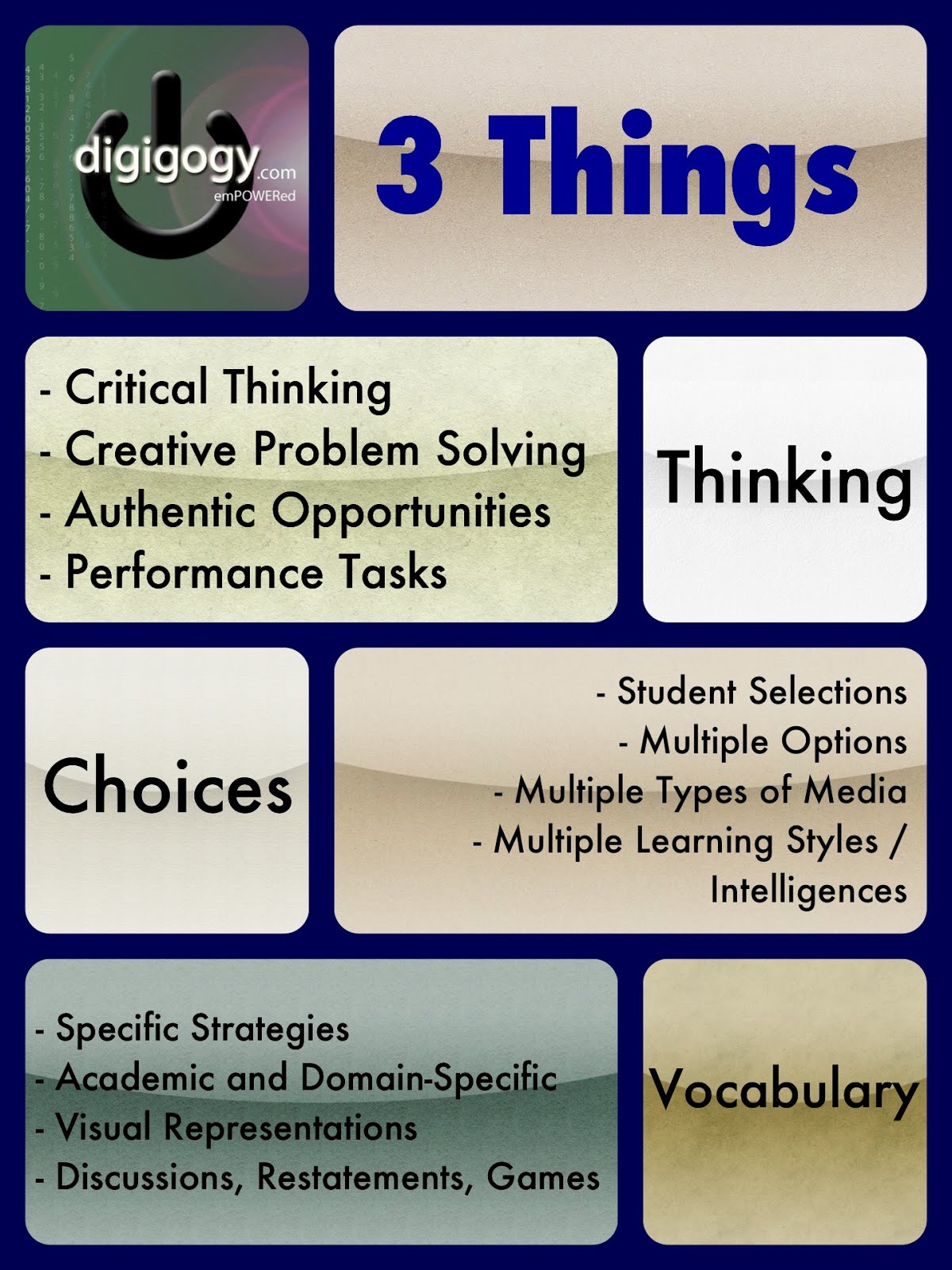
You only have to do three things. That’s right, just three things. Consider invigorating your curriculum with the following:

  • Choices
  • Thinking
  • Vocabulary

While there may be mountains of considerations with the new standards, their associated new assessments, and the tie-in to new teacher evaluations, these three things are really the core of your curriculum conversations and actions, no pun intended.


I’ve highlighted a few considerations in each of the three categories in the visual though there are a myriad strategies to engage in.
I would suggest research based / peer reviewed strategies versus textbook driven decisions, however. In a lot of schools, much emphasis is placed on the textbook as the driver of the curriculum and then there is shock and disappointment when the students don’t perform. Modernizing our work means that there must be a focus on the essential learning needs of students and truly preparing them for college and/or careers, and not on what a salesman would like for us to believe.
These three things are the learning essentials. They are the roots of good instruction and attending to them in specific and purposeful ways will help you align to new standards, prepare for new assessments, and prepare students for the world they will graduate into.
Heath, C., & Heath, D. (2011). Switch, how to change things when change is hard. (1st ed.). New York: Crown Business.
Mike on Twitter: @fisher1000
Upgrade Your Curriculum: Practical Ways to Transform Units and Engage Students - coming in Feb. 2013 from ASCD
Cure for the Common Core - eBook available now from Amazon

...

Monday, December 3, 2012

Put the Kibosh on Bloom's APPortunities


I read yet another blog post this morning about sorting and parsing APPs and Web 2.0 tools according to Bloom’s Levels. Back in 2009, I created a Bloom’s Pyramid of Web 2.0 tools and did the same sorting and parsing. Almost immediately, it was apparent that I did this wrong. (Which I discovered as I conversed and thought this through with my Digital PLN!) However, it sparked a conversation, a REALLY good conversation, about the thinking that goes into how a tool is being used as well as the importance of the TASK behind it. The wiki is still open that I collaboratively created with @paulawhite if you’d like to visit.

Since 2009, the images have been copied, remixed, recreated, added to, expanded, and more. However, the same flaw still exists:

Putting a web tool or APP somewhere on the hierarchy is useless. It does not represent the intention of critical thinking levels in any form, whether it’s Bloom’s or Webb’s DOK levels, or Costa’s Thinking Levels. Whatever is being used, is being used in the wrong way.

The real critical thinking revolves around understanding how to use a Web tool or APP at ALL OF THE LEVELS. All the charts and images are cute, but they don’t represent a real transfer of thinking at the applied level.

Let’s start a new conversation, perhaps by adding comments to the CONTRIBUTE area of the Visual Bloom’s Wiki, or by commenting here. I can start importing those suggestions into WIX and expanding the interactivity of the Digital Visual Bloom’s.  If the web tool or APP is not on the CONTRIBUTE list already, you can add it yourself and we can crowdsource this larger conversation.

Leveling web tools and APPs is past-thinking. Understanding how the tools and APPs live on multiple levels is future-thinking. What we did back then was good, and now that we know better, let’s make it happen!


Mike on Twitter: @fisher1000

Upgrade Your Curriculum: Practical Ways to Transform Units and Engage Students - coming in Feb. 2013 from ASCD
Cure for the Common Core - eBook available now from Amazon

...

Monday, November 26, 2012

Adopt. Adapt. Adept.


I had a great conversation this morning with Professional Developers from different parts of New York State as we discussed the implementation of Curriculum Modules in their respective districts.

Some were saying that they adopted the modules as they were published, including all associated resources and materials. Some said they adapted the ideas and framework of the modules, but changed some of the resources, materials and strategies based on their population of students and available books. I shared that I thought it would be important for teachers, as they adopted and adapted, to become “module specialists.” I thought it would be a good idea for them to know the structure of the module so well that the adaptations were multifaceted and assessment focused. (Not state test focused, necessarily, but evaluation of learning focused.)

It dawned on me that this was a pretty decent cycle for implementation. Teachers could jump in at either the adopt or adapt zones, then become adept at the structure and process, something along the lines of:

Adopt:
Teach the unit/module/lesson “AS IS” while looking for opportunities for improvement.

Adapt:
Teach the unit/module/lesson in a “MODIFIED” way with new strategies and resources.

Adept:
Teach the unit/module/lesson in a “SKILLED REVISION” mode with full understanding of process and structure of unit with attention to assessment and appropriate strategies and resources for:

  • Engagement
  • Student Centered Work
  • Problem Solving and Critical Thinking
  • College and Career Capacities
  • Modern Learning Practices

I think anyone that reads me regularly probably already knows that I’m not a fan of canned curriculum or curriculum module “gifts.” I believe the curriculum design and action plan is a purposeful and thoughtful process that begins with the end in mind, aligns to specific standards, and is considerate of specific populations of students and the resources a school may have. Teaching from these canned modules removes some of the most important factors of curriculum work, namely conversation and collaboration among colleagues.

That said, as I continue to do curriculum work, sometimes concessions need to be made for those who may see a marked improvement by working in the “Adopt” zone. That experience leads to learning how to adapt, which in turn may eventually lead to working adeptly.

In this Brave New Educational World with new standards, new planned curricula, new data considerations, and new teacher accountability, anything we do better in the best interest of kids is a step in the right direction. The impetus is upon us all to enter into curriculum work with open minds and high expectations that as we know better, we do better.*


*Partially taken from a quote from Toni Morrison on the Oprah Winfrey show.

Special thanks to colleagues Carol Bush from Orleans / Niagara BOCES and Dr. Marla Iverson from Wayne Finger Lakes BOCES for a great conversation and for thinking new ways.

Follow Mike on Twitter: @fisher1000

Upgrade Your Curriculum: Practical Ways to Transform Units and Engage Students coming from ASCD in February 2013
Cure for the Common Core, eBook available now from Amazon Kindle Store

Sunday, September 23, 2012

Assessment Priorities: Advancing Curriculum Mapping

'The Great Wall' photo (c) 2005, moniqca - license: http://creativecommons.org/licenses/by-nd/2.0/


Assessment is the cornerstone of all curriculum design.

When we begin with the end in mind, a la Jay McTighe’s and Grant Wiggin’s work in Understanding by Design, we set a path for success focused on a target. (Read Chapter 11--it’s an eye opener!)

Some of you may remember how the Triple A company used to prepare Travel Triptiks for customers in a pre-Google Map world. Triptiks were a trip planning tool that were designed with the destination in mind. As you traveled from your current location to your intended destination, you were given different routes, points of interest, and drop-in suggested side trips that would enhance your journey while still achieving your desired destination. In order to create the Triptik, though, you had to identify the destination. Otherwise, how would you plan your trip?

I think of these often when I think about curriculum. The assessment is our destination. Our path is the Triptik. Side trips are awesome, different points of interest are engaging, and we don’t have to travel the same linear path as everyone else.

The problems arise when we know our destination, but travel to other places instead. For instance, if I lived in Jacksonville, Florida and wanted to travel to San Antonio, Texas; I wouldn’t stop in Chicago first. I’m sure that comparison is clear enough, but it’s not so neat when we think about curriculum design. Whatever our objective is, depending on the standards we are addressing, it is dependent on the instruction we offer to our students. If an assessment asks students to evaluate and create but our instruction asks only that they remember and comprehend, then we’ve taken a wrong direction somewhere and end up in a swamp of learning limbo.

So how to remedy the opposite of symbiotic planning? Think cognition. Think purpose. Think of how you’re going to ask kids to prove what they’ve learned.

Most of the states in the country are aligning instruction and assessment to the Common Core. In the course of upgrading curriculum and/or curriculum maps, many are paying attention to the instructional elements but not necessarily the assessment elements.

In a recent conversation with second grade teachers, I discovered that students were really falling down on the common assessments that the teachers were using in math. I asked the teachers what they thought was going on. Some responded that the students were just lazy and others thought that the tests were just too hard. I asked them if they had really looked at the test questions. I asked them if they were teaching the skills that the students would need to answer the questions successfully. I asked if the skills to answer the questions correctly were part of their “planned-for” instruction and whether or not they were represented in their curriculum maps.

They weren’t sure. So, question by question, we broke down the skills a student would need to answer a particular question correctly. What we discovered was that those skills aren't necessarily being taught. It was an uncomfortable conversation, but the teachers were using worksheets that came with their math textbooks, as they always had, and using assessments that represented the standards and were created by the teachers. There was a mismatch. The rigor of the instruction rarely matched the rigor of the assessment.

I have to admit, there were some tears in that workshop. The reliance on the worksheets and the assumption that they were building fluency were flawed. They were preparing kids for Chicago, but not San Antonio.

In order to impact learning, we have to be cognizant of and plan for the intricacies of curriculum symbiosis. That means that instruction and assessment must have a high degree of parallelism in terms of levels of cognition, types of activities, individual student priorities, content, etc. Our main curriculum priority upgrade focus, then, must be assessments. I know some may read this and see the message: “teach to the test.” Just to clarify, that is NOT what I’m saying here. What I’m advocating for is to teach FOR the test. If instruction prepares students well, then the assessment will be a true measure of learning versus a hope and a prayer that students “get it.”

In our upcoming ASCD book, Upgrade Your Curriculum: Practical Ways to Transform Units and Engage Students, (Tentative Feb. 2013) Janet Hale and I discuss assessment as an entry level to transforming instructional design and practice. This includes the examination of curriculum, assessments, instruction of the future versus instruction of the past, and more. We recently found out, as planned in the writing of the book, that we will be able to leverage ASCD Edge to amplify the book and have interactive moments between us and our readers.

This interactive/social element will be coming in mid-January / early February just before the book is to be published. In the meantime, we’ll be blogging about the elements of the upgrades and transformations that we are describing in the book. With this post, and our previous post on “Planting A Seed,” we will be looking at advancing curriculum design and practice as well as share additional examples of Upgrades and Transformations from the field.


Cure for the Common Core eBook now available.
...

Sunday, September 9, 2012

3 Tips To Communicate More Effectively Via Social Media


Guest Post from my friend and colleague, Bena Kallick...
Bena Kallick, Eduplanet21
Are you having trouble listening with understanding and empathy (one of the Habits of Mind) when you are not face to face with the other person–on facebook, Google+, twitter, or other social networks?  As an educator, staying in touch with your professional learning network digitally is a boon to the quantity of communication, but without the proper habits, you may not be reaping the quality you might.
Inspired by the thinking from my work with Art Costa at the Institute for the Habits of Mind, here are some tips:
1. Pause
Do you find it hard to manage your impulsivity? Do you want to just respond, like, or share and get it done to move on to the next task? This diminishes the quality and substance of your interactions. As you pause, prioritize the messages that you value most and send them in an order that allows you to invest the appropriate focus on each one.
We are all captive to this experience so when you find yourself engaged in an important issue with someone else–on another network, or in person, minimize the browser window, or even get up from the computer altogether to help shift cognitive “maps,” then return to the computer when you have some time. This would be equivalent to the pause button that we use when we are engaged with someone face to face.
2. Paraphrase
It is often the case that we think we understand what another person is saying and we jump to conclusions without checking to see if we truly understand. Paraphrasing is a very useful tool when in a web based conference. For example, when there are many people communicating at once–in-person, on a conference call, or even on a social media platform–it helps to paraphrase what you understand are the key points.
At the same time, you are helping to summarize and make sense out of the multiple perspectives, an important thinking and communication skill. This also reduces the temptation to simply get your .02 in without respecting the topic or purpose of others involved in the communication.
3. Probe
Good questions serve to clarify as well as extend the communication and the thinking. Especially with social learning, good questions are the start for good feedback. Probing what the other is saying shows respect for the other person’s thinking, and a curiosity about how that thinking might influence yours.
Why is this so important? Most people are living at least one half of their professional life in social learning or communication of one sort or another.
How do you use–or fail to use–thinking and communication habits (Habits of Mind, for example) as a guide for making your work in education meaningful?
Image attribution flickr users tanyaalittle and nostraimago
Bena Kallick

Bena Kallick

Bena Kallick is well known for her work in curriculum, instruction and assessment with an organizational focus on change. Her publications with a focus on thinking and the habits of mind include: Assessment in the Learning Organization, Assessment Strategies for Self-Directed Learning, Learning and Leading with Habits of Mind, and Habits of Mind Across the Curriculum (all co-authored with Art Costa). She currently works with Eduplanet21.

Friday, September 7, 2012

Power to the Students: Why Educators Need to Pay Attention to Student Discontent


This blog post is being simultaneously published with a companion piece on ASCD Edge, which you can read here. In it, Allison Zmuda interviews the subject of this blog post for additional insight into giving Power To The Students...

'Student Protest: Liverpool Walkout' photo (c) 2010, Matt Baldry - license: http://creativecommons.org/licenses/by/2.0/

Meet Nikhil Goyal, a seventeen-year old high school senior: http://nikhilgoyal.me/

Nikhil has written a new book, One Size Does Not Fit All, a call to arms to the educational community that provocates with the voices that matter the most: students. Despite all of the political rhetoric and haggling in the press about one side or the other’s best intentions for students, it’s really the students that have the most to lose if we don’t get this right, and the most to gain if we do. In order to do the best we can for the next generation, we need to make them part of the process.
  • How often do we ask students their opinion about what they want to learn? How they want to learn it?
  • How often do we give them a real audience for their work? How often do we give regular, action-oriented feedback so students can improve their work because of their target audience?

Nikhil, in writing his book, has interviewed hundreds of peers, policy makers, and forward thinkers such as Howard Gardner, Seth Godin, Dan Pink, Noam Chomsky, and Diane Ravitch. In an effort to extend the message of Nikhil’s new book, we want to continue the collection of data around student perceptions of school and their school experience. Based on the data analysis, we can start making some real connections to intentional shifts and craft a plan of action around learning in the 21st Century.

We are asking our learning community to help us collect this data through a student engagement survey:  https://www.surveymonkey.com/s/juststartkidsurvey

Why should you encourage students to take the survey?
1. It demonstrates that you care about them.
2. It demonstrates that you want to design meaningful learning experiences for them.
3. It demonstrates that you also grow from feedback based on your target audience.

Why should students take the survey?
1. It demonstrates that what they say matters.
2. It demonstrates that their ideas can spark new innovations in their own classrooms as well as create movement in classrooms around the country and the world.
3. It demonstrates the power of individual contribution in service to a larger cause.

What’s in it for you?
With school starting back up, we want to engage as many students as possible in the data collection. In return, we will give continual updates through ASCD Edge and on our individual sites about what the data suggests in terms of upgrading the learning for all students.

Sometime in the next two weeks, we are looking to collect as many responses as possible from schools around the country. The more information we collect, the better the conclusions we can draw about innovations for modern learning design and practice.

Please Tweet, Blog, Share, Pin, Email, EduClip, whatever you can to help get the survey out! On his “ABOUT” page, Nikhil shares a quote from Seth Godin, “When enough of us act, the system will have no choice but to listen, emulate and rush to catch up.” It’s time to stand up and act decisively. We have a duty to our children to get this right or future generations will suffer tremendously from the status of our schools. A generation is a terrible thing to go to waste.

This blog post was collaboratively written by:
Mike Fisher, a prolific blogger, educational consultant, and author: digigogy.com
Allison Zmuda, an educational consultant, author, and proud creator of a new venture: just-startkidsandschools.com.

Follow Mike on Twitter: @fisher1000
Follow Allison on Twitter: @compclass
Follow Nikhil on Twitter: @nikhilgoya_l